
SLEEP
Ambien (Zolpidem): Side Effects, Risks and Why Doctors Limit It
Ambien (zolpidem) is approved for short-term insomnia. Here is what the FDA label says about dosing and side effects, why the FDA added a boxed warning in 2019 and lowered the dose for women in 2013, why the Beers Criteria advise older adults to avoid it, and what to discuss with a clinician.

The Zest Team
· 6 min read
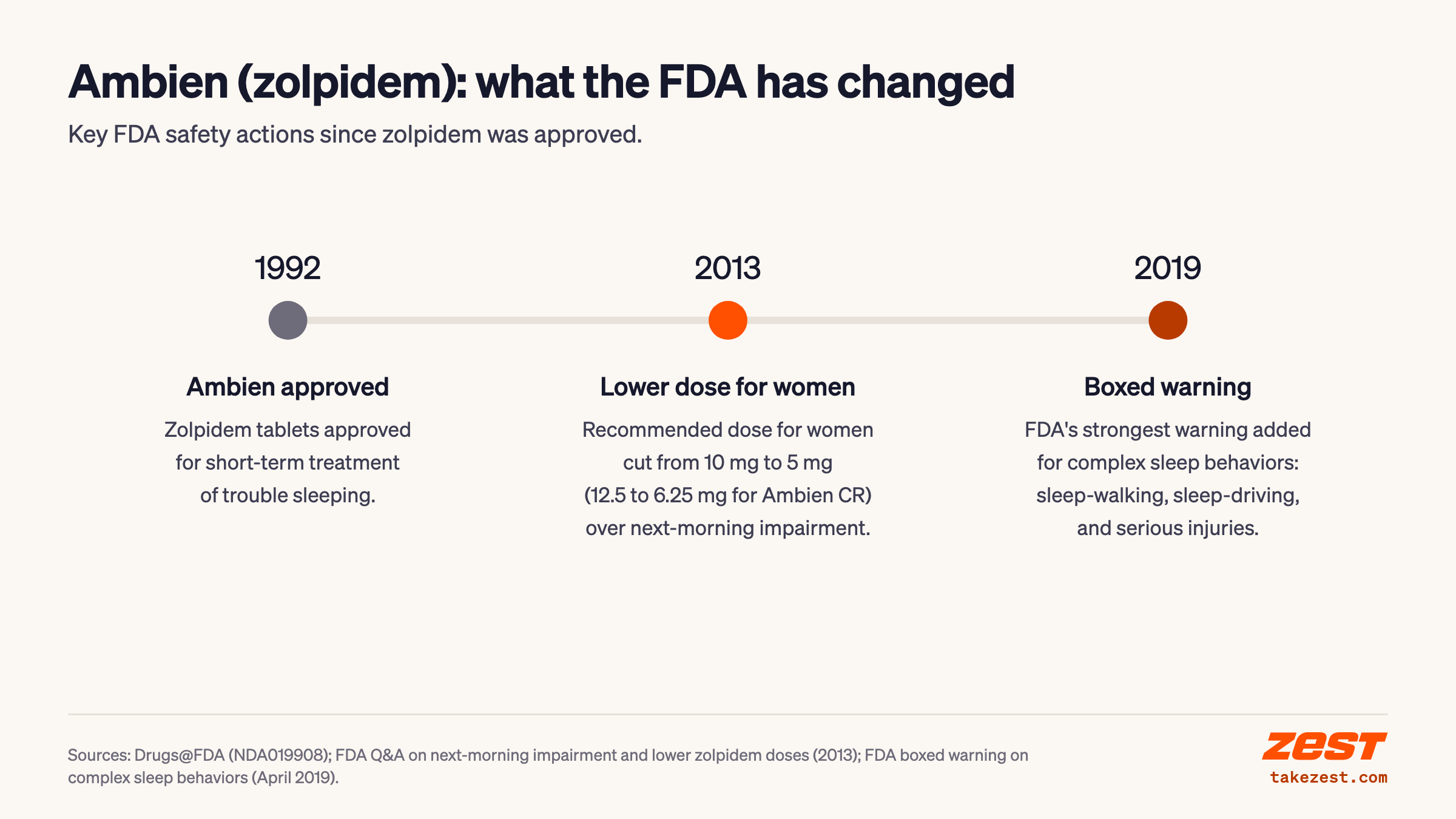
Ambien is the brand name for zolpidem, a prescription sleeping pill approved by the FDA in 1992 for the short-term treatment of trouble falling asleep. It is a sedative-hypnotic, often called a Z-drug. It can help some people for a short time, but it carries an FDA boxed warning for complex sleep behaviors, and its label says long-term use is not recommended.
Here is what the label says about dosing, what the trials found, and the risks behind sleep specialists' caution: sleep-driving, next-morning impairment, dependence and falls. This is educational information, not medical advice; talk to a licensed clinician before starting or stopping any medication.
Ambien at a glance
| Generic name | Zolpidem tartrate |
|---|---|
| Brand name | Ambien and Ambien CR (Cosette Pharmaceuticals) |
| Drug class | Sedative-hypnotic (GABA-A receptor positive modulator, a "Z-drug") |
| FDA approval | Ambien: December 16, 1992, short-term treatment of trouble falling asleep. Ambien CR: September 2, 2005, trouble falling and/or staying asleep |
| Controlled substance | Yes, DEA Schedule IV |
| Strengths | Ambien 5 and 10 mg; Ambien CR 6.25 and 12.5 mg extended-release |
| Usual dose | Ambien: 5 mg for women, 5 or 10 mg for men, immediately before bed with 7–8 hours left before waking; no more than 10 mg a night |
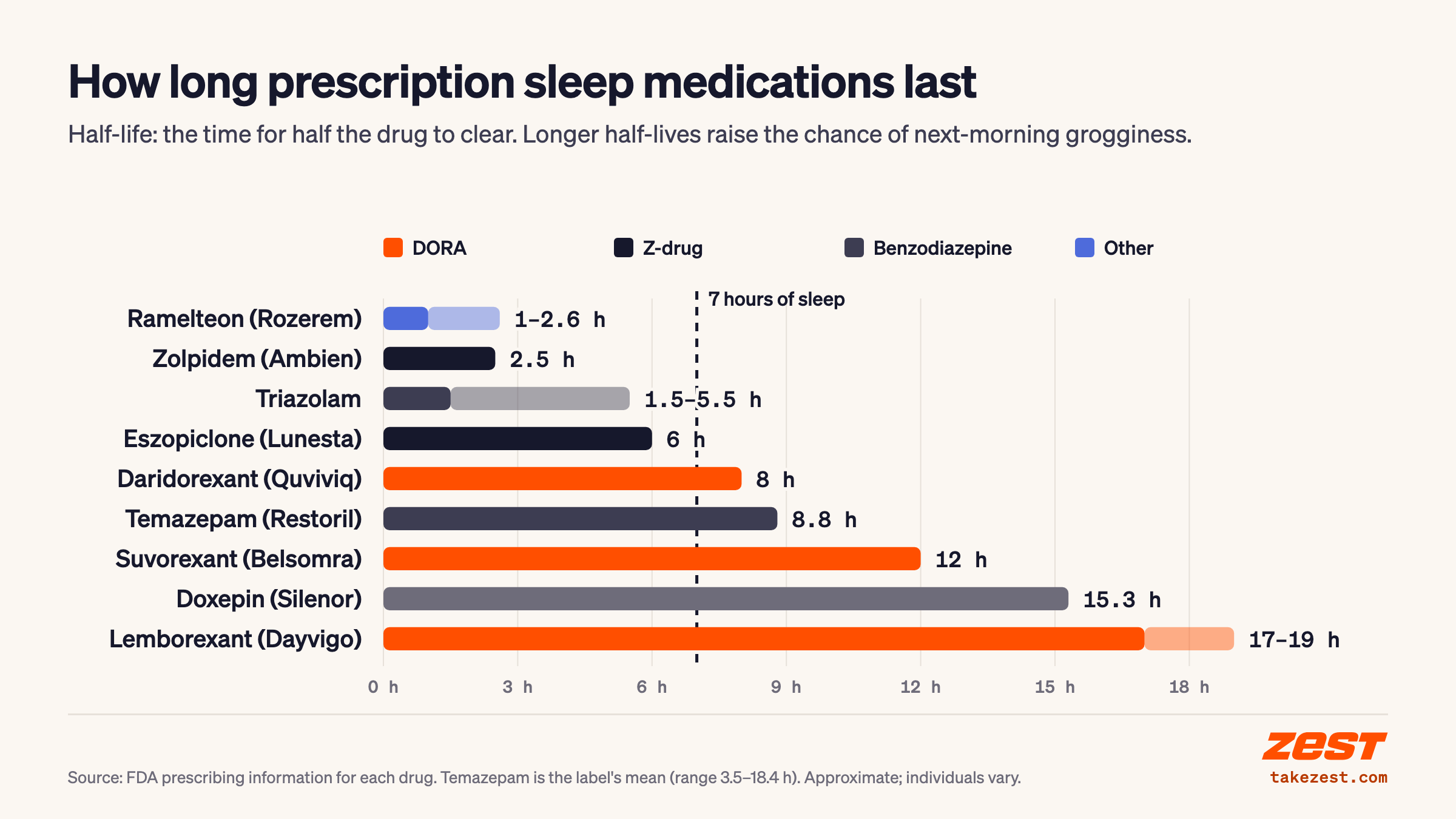
| Half-life | About 2.5 hours (peak about 1.6 hours after a dose) |
| Boxed warning | Complex sleep behaviors, such as sleep-walking and sleep-driving |
| Not for | Anyone who has had a complex sleep behavior on zolpidem, or is allergic to it |
| Generic available | Yes |
How does Ambien work?
Zolpidem boosts GABA, the brain's main "brake" signal, by binding to the benzodiazepine site on certain GABA-A receptors. It is not chemically a benzodiazepine, but it acts on the same receptor family, which is why it shares many of their risks.
Dual orexin receptor antagonists (DORAs) work differently: they block orexin, the brain's "stay awake" signal, instead of sedating the brain broadly. See our guide to Belsomra (suvorexant).
How to take Ambien (dosage)
- The FDA label's starting dose is 5 mg for women and 5 or 10 mg for men, once a night immediately before bed, with at least 7–8 hours before waking. Women start lower because they clear zolpidem more slowly.
- The maximum is 10 mg, taken once. Do not redose the same night.
- Ambien CR starts at 6.25 mg for women and 6.25 or 12.5 mg for men (12.5 mg maximum). Swallow it whole.
- Adults over 65 and people with mild to moderate liver problems take 5 mg (Ambien) or 6.25 mg (Ambien CR). Avoid it with severe liver impairment.
- Food slows how quickly it works.
- Use the lowest effective dose for as short a time as possible, and do not take it if you drank alcohol that evening.
Other zolpidem forms: Edluar, a tablet that dissolves under the tongue; low-dose 1.75 and 3.5 mg sublingual tablets for middle-of-the-night waking with at least 4 hours left in bed (first sold as Intermezzo, now discontinued, with generics available); and a 7.5 mg capsule approved in 2023.
Does Ambien work? What the trials found
In a 5-week trial in the label, zolpidem 10 mg helped people fall asleep faster than placebo for the first 4 weeks, but did not reduce the number of awakenings. A 2012 BMJ meta-analysis of FDA trial data for zolpidem, eszopiclone and zaleplon found that Z-drugs shortened the time to fall asleep in the sleep lab by about 22 minutes versus placebo, an effect the authors called small and of questionable clinical importance.
Ambien side effects and risks
In the label's placebo-controlled trials of up to 35 nights:
| Side effect | Zolpidem (≤10 mg) | Placebo |
|---|---|---|
| Drowsiness | 8% | 5% |
| Dizziness | 5% | 1% |
| Allergy | 4% | 1% |
| Dry mouth | 3% | 1% |
| Lethargy | 3% | 1% |
The more serious risks are in the label's warnings:
- Complex sleep behaviors (boxed warning). Sleep-walking, sleep-driving, cooking or making calls while not fully awake, usually with no memory of it. Some events caused serious injury or death. The FDA required this boxed warning for zolpidem, eszopiclone and zaleplon in 2019. It can happen after the first dose, at recommended doses, with or without alcohol.
- Next-morning impairment. In 2013 the FDA lowered the recommended dose for women from 10 mg to 5 mg (12.5 mg to 6.25 mg for Ambien CR) because morning blood levels could impair driving, even in people who feel awake. The risk was highest with the extended-release form.
- Tolerance and dependence. The label says dependence can develop, with risk rising with dose and length of use. Withdrawal symptoms range from insomnia and low mood to a more serious syndrome that can include tremors and seizures.
- Rebound insomnia. The label's studies found no measured rebound at recommended doses, but older adults reported worse sleep the first night off doses above 5 mg.
- Alcohol and other sedatives, including opioids, add to zolpidem's effects and can slow breathing.
- Also: abnormal thinking or behavior, worsening depression, and severe allergic reactions.
Don't stop a sleep medication suddenly, especially a benzodiazepine; withdrawal can be serious. Talk to your prescriber about tapering.
Why doctors limit Ambien, especially after 65
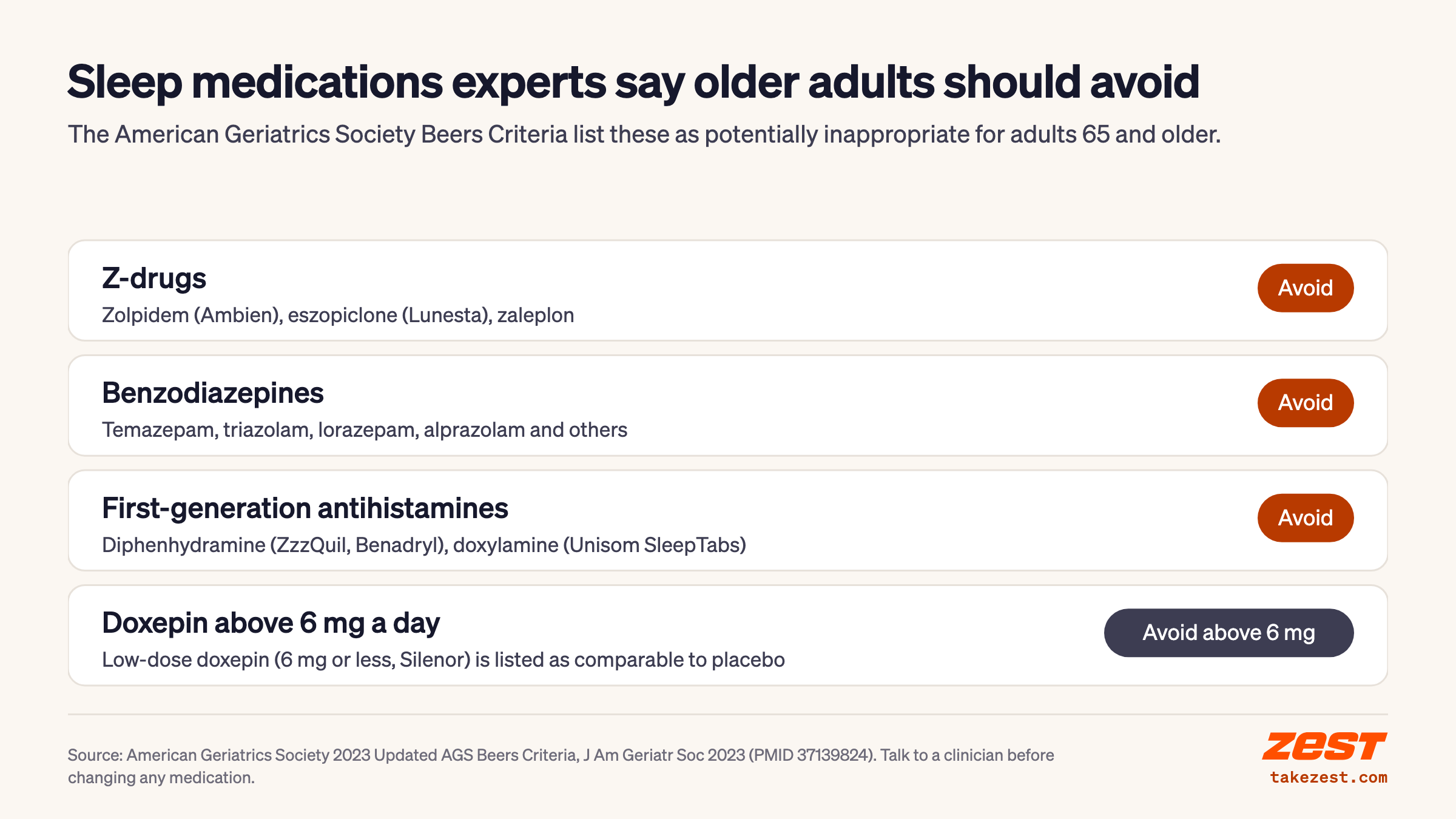
The label warns that zolpidem raises the risk of falls, particularly in older adults. The American Geriatrics Society's 2023 Beers Criteria advise adults 65 and older to avoid Z-drugs, citing delirium, falls, fractures, hospital visits and car crashes, with minimal improvement in sleep. In a Mayo Clinic study of hospital inpatients, falls were more common in those given zolpidem (3.04%) than in those prescribed it who did not take it (0.71%), an association rather than proof of cause.
Ambien vs. Belsomra
| Ambien (zolpidem) | Belsomra (suvorexant) | |
|---|---|---|
| How it works | Boosts GABA | Blocks orexin |
| Approved for | Short-term, trouble falling asleep | Trouble falling and/or staying asleep |
| Half-life | About 2.5 hours | About 12 hours |
| Controlled substance | Schedule IV | Schedule IV |
| Boxed warning | Complex sleep behaviors | None (listed as a warning) |
| Generic available | Yes | No |
Both can cause next-day impairment. The right fit depends on your sleep pattern, age and other medications.
Alternatives to discuss with a clinician
Cognitive behavioral therapy for insomnia (CBT-I) is a structured, non-drug program for chronic insomnia. If medication is still needed, a clinician may discuss DORAs such as Quviviq (daridorexant) and Dayvigo (lemborexant). DORAs are not risk-free: they are also Schedule IV and share warnings such as next-day impairment and complex sleep behaviors. For the other common Z-drug, see our Lunesta (eszopiclone) guide.
How to get Ambien prescribed
Zolpidem is a controlled substance, so it needs a prescription from a licensed clinician after an evaluation of your sleep, health and medications. Good sleep habits and CBT-I come first; medication works best alongside them.
Zest RX for sleep. Zest is preparing to launch telehealth for sleep, connecting you with licensed providers who can evaluate whether a prescription option fits your needs. Join Zest RX early access.
Frequently asked questions
Is Ambien addictive?
The FDA label says Ambien can cause physical and psychological dependence, and the risk grows with higher doses and longer use. It is a Schedule IV controlled substance, and people with a history of substance misuse are at higher risk.
The FDA label says Ambien can cause physical and psychological dependence, and the risk grows with higher doses and longer use. It is a Schedule IV controlled substance, and people with a history of substance misuse are at higher risk.
What is the half-life of zolpidem?
About 2.5 hours on average for Ambien, according to the FDA label, with a range of roughly 1.4 to 4.5 hours. It is longer in older adults and in people with liver cirrhosis.
About 2.5 hours on average for Ambien, according to the FDA label, with a range of roughly 1.4 to 4.5 hours. It is longer in older adults and in people with liver cirrhosis.
Can you take Ambien with alcohol?
No. The label says not to take Ambien if you drank alcohol that evening or before bed. Alcohol adds to zolpidem's sedation and worsens impairment of driving and coordination.
No. The label says not to take Ambien if you drank alcohol that evening or before bed. Alcohol adds to zolpidem's sedation and worsens impairment of driving and coordination.
Why is the Ambien dose lower for women?
Women clear zolpidem more slowly, so the same dose leaves higher blood levels the next morning. In 2013 the FDA lowered the recommended starting dose for women to 5 mg, or 6.25 mg for Ambien CR.
Women clear zolpidem more slowly, so the same dose leaves higher blood levels the next morning. In 2013 the FDA lowered the recommended starting dose for women to 5 mg, or 6.25 mg for Ambien CR.
Ambien vs. Ambien CR: what is the difference?
Ambien is immediate-release and approved for trouble falling asleep. Ambien CR is extended-release and approved for trouble falling and/or staying asleep. The FDA said next-morning impairment risk was highest with the extended-release form.
Ambien is immediate-release and approved for trouble falling asleep. Ambien CR is extended-release and approved for trouble falling and/or staying asleep. The FDA said next-morning impairment risk was highest with the extended-release form.
Is there a generic for Ambien?
Yes. Generic zolpidem tartrate is approved as regular tablets, extended-release tablets and sublingual tablets, according to FDA records, so most people can be prescribed a generic version.
Yes. Generic zolpidem tartrate is approved as regular tablets, extended-release tablets and sublingual tablets, according to FDA records, so most people can be prescribed a generic version.
Sources
- AMBIEN (zolpidem tartrate) prescribing information. DailyMed
- AMBIEN CR prescribing information. DailyMed
- FDA. Certain prescription insomnia medicines: new boxed warning. April 30, 2019. FDA
- FDA. Risk of next-morning impairment after use of insomnia drugs; lower recommended doses for zolpidem. January 2013. FDA
- 2023 AGS Beers Criteria Update Expert Panel. J Am Geriatr Soc. 2023;71(7):2052-2081. PubMed
- Huedo-Medina TB, et al. Effectiveness of non-benzodiazepine hypnotics in treatment of adult insomnia. BMJ. 2012;345:e8343. PubMed
- Kolla BP, et al. Zolpidem is independently associated with increased risk of inpatient falls. J Hosp Med. 2013;8(1):1-6. PubMed
SLEEP
INSOMNIA
SLEEP MEDICATION