SLEEP
Belsomra (Suvorexant): How It Works, Dosage and Side Effects
How Belsomra (suvorexant) works, how it's taken, what the trials found, its side effects, and how it compares with Ambien, Dayvigo and Quviviq.

The Zest Team
· 5 min read
Belsomra is the brand name for suvorexant, a prescription sleep medication from Merck approved by the FDA in 2014 for adults who have trouble falling asleep or staying asleep. It was the first dual orexin receptor antagonist (DORA): instead of sedating the whole brain like Ambien, it blocks orexin, the brain chemical that keeps you awake.
Here is how Belsomra works, how it is taken, what the trials found, its side effects, and how it compares with Ambien and the newer DORAs. This is educational information, not medical advice; talk to a licensed clinician before starting or stopping any medication.
Belsomra at a glance
| Generic name | Suvorexant |
|---|---|
| Brand name | Belsomra (Merck) |
| Drug class | Dual orexin receptor antagonist (DORA) |
| FDA approval | August 13, 2014, for trouble falling asleep and/or staying asleep |
| Controlled substance | Yes, DEA Schedule IV |
| Strengths | 5, 10, 15 and 20 mg tablets |
| Usual dose | 10 mg, within 30 minutes of bed, with at least 7 hours before waking; up to 20 mg if 10 mg is tolerated but not enough |
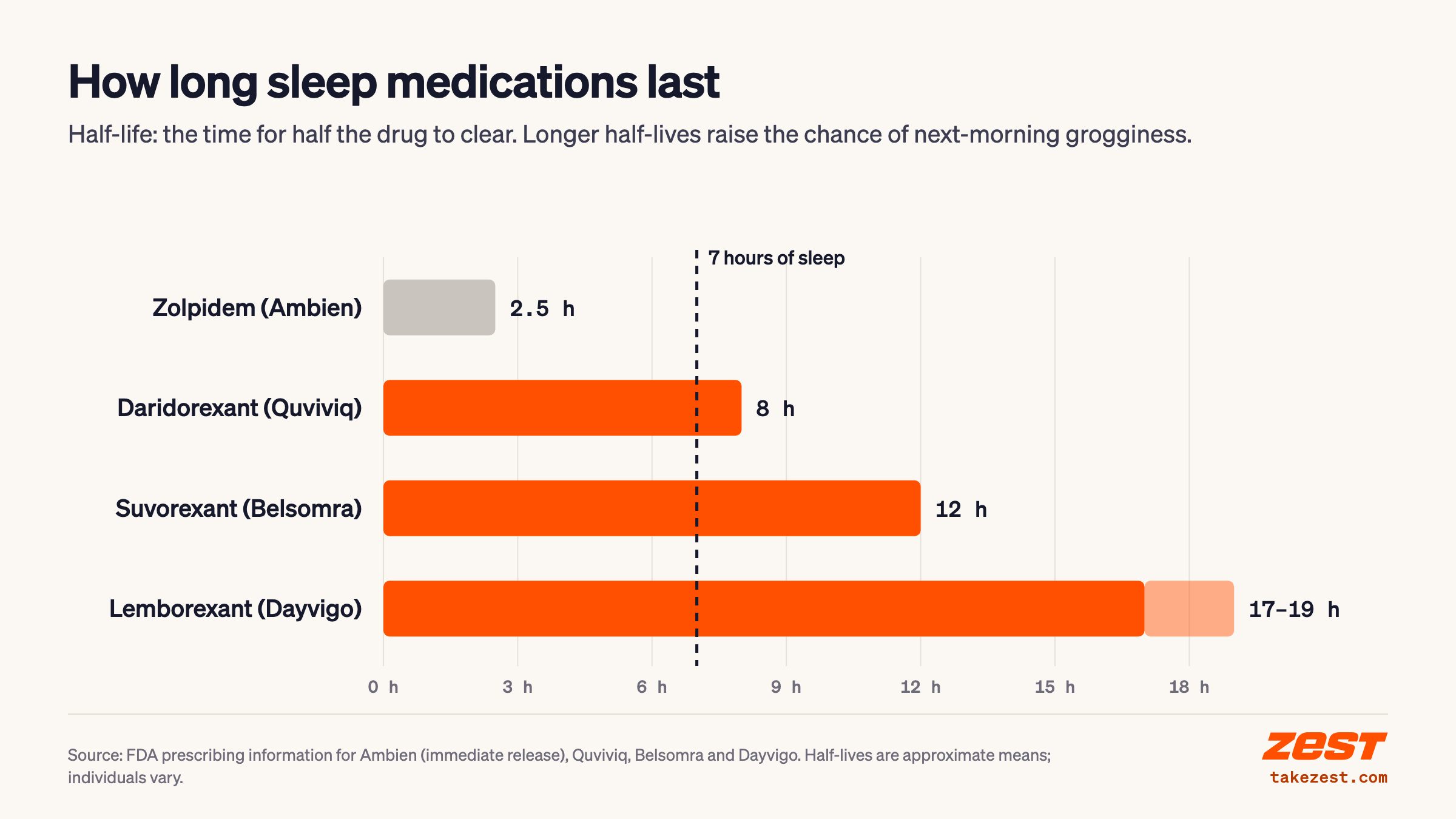
| Half-life | About 12 hours (peak levels about 2 hours after a dose) |
| Not for | People with narcolepsy |
How does Belsomra work?
Your brain makes a small amount of orexin (also called hypocretin), a signal that holds you in the "awake" state. Orexin is high during the day and falls at night. Suvorexant blocks both orexin receptors, OX1R and OX2R, which turns the wake signal down so your normal sleep drive can take over.
That is a different approach from the older sleeping pills. Ambien (zolpidem), Lunesta (eszopiclone) and benzodiazepines boost GABA, the brain's main "brake," which sedates the brain broadly. Belsomra leaves GABA alone and targets only the wake signal. For a deeper look at the whole class, see our guide to DORAs and daridorexant (Quviviq).
How to take Belsomra (dosage)
- The FDA label's recommended starting dose is 10 mg, taken no more than once a night, within 30 minutes of going to bed, with at least 7 hours left before you plan to wake.
- If 10 mg is well tolerated but not effective, a prescriber can raise it. The maximum is 20 mg a night.
- Taking it with or soon after a meal can delay how quickly it works.
- Some other medicines raise suvorexant levels (moderate CYP3A inhibitors such as some antifungals and antibiotics), and the label lowers the dose for them. Tell your prescriber everything you take.
- Do not combine it with alcohol or other sedatives, and do not drive the next day until you know how it affects you.
Does Belsomra work? What the trials found
Merck's two pivotal 3-month trials, published in Biological Psychiatry in 2016, enrolled more than 2,000 adults with chronic sleep trouble. Suvorexant improved both how quickly people fell asleep and how well they stayed asleep compared with placebo, measured by sleep diaries and in the sleep lab, at week 1, month 1 and month 3. Fewer than 5% of people stopped because of side effects, and there was no marked rebound or withdrawal when it was stopped.
One detail worth knowing: most of the trial participants took 30–40 mg, above today's 20 mg maximum. The approved doses (15–20 mg in the trials) also beat placebo on total sleep time and staying asleep, and the FDA settled on starting at 10 mg, the lowest dose expected to help.
Belsomra side effects
The most common side effect on the label is sleepiness the next day: 7% of people on 15–20 mg versus 3% on placebo in the 3-month trials. Other warnings shared by the DORA class:
- Next-day impairment, which is dose-related. The label cautions people taking 20 mg against next-day driving and other activities that need full alertness.
- Complex sleep behaviors such as sleep-walking or sleep-driving with no memory of it.
- Sleep paralysis, hallucinations around sleep, and cataplexy-like weakness, which are rare.
- Worsening depression or suicidal thoughts in some people.
- Care is needed with breathing problems such as sleep apnea or COPD.
Stop and call your clinician if you notice any of the serious effects.
Belsomra vs. Ambien
| Belsomra (suvorexant) | Ambien (zolpidem) | |
|---|---|---|
| How it works | Blocks the orexin "wake" signal | Boosts GABA to sedate the brain |
| Half-life | About 12 hours | About 2.5 hours (immediate release) |
| Controlled substance | Schedule IV | Schedule IV |
| Boxed warning | None | Complex sleep behaviors |
| Generic available | No | Yes |
Ambien acts fast and wears off fast. Belsomra lasts longer, which helps people who wake in the night but makes next-morning drowsiness more likely at higher doses. Neither is universally better; the right choice depends on your sleep pattern, health history and other medications.
Belsomra vs. Quviviq vs. Dayvigo
| Medication | Approved | Half-life | Usual dose |
|---|---|---|---|
| Belsomra (suvorexant) | 2014 | About 12 hours | 10 mg (up to 20 mg) |
| Dayvigo (lemborexant) | 2019 | 17–19 hours | 5 mg (up to 10 mg) |
| Quviviq (daridorexant) | 2022 | About 8 hours | 25–50 mg |
All three are Schedule IV DORAs with the same warnings. The practical difference is how long they last. See our guides to Dayvigo (lemborexant) and Quviviq (daridorexant).
How to get Belsomra prescribed
Belsomra is a controlled substance, so it needs a prescription from a licensed clinician after an evaluation of your sleep, health and medications. Good sleep habits and cognitive behavioral therapy for insomnia (CBT-I) remain the first step; medication works best alongside them.
Zest RX for sleep. Zest is preparing to launch telehealth for sleep, connecting you with licensed providers who can evaluate whether a prescription option fits your needs. Join Zest RX early access.
Frequently asked questions
Is Belsomra a controlled substance?
Yes. Suvorexant is a DEA Schedule IV controlled substance, the same schedule as Quviviq, Dayvigo and Ambien. It can only be dispensed with a prescription.
Yes. Suvorexant is a DEA Schedule IV controlled substance, the same schedule as Quviviq, Dayvigo and Ambien. It can only be dispensed with a prescription.
How long does Belsomra stay in your system?
Its half-life is about 12 hours, according to the FDA label, so it can still be active in the morning. That is why the label says to allow at least 7 hours of sleep after a dose.
Its half-life is about 12 hours, according to the FDA label, so it can still be active in the morning. That is why the label says to allow at least 7 hours of sleep after a dose.
Is Belsomra a benzodiazepine?
No. Belsomra is a dual orexin receptor antagonist. It blocks the orexin wake signal and does not act on GABA the way benzodiazepines and Z-drugs do.
No. Belsomra is a dual orexin receptor antagonist. It blocks the orexin wake signal and does not act on GABA the way benzodiazepines and Z-drugs do.
What is the generic name for Belsomra?
Suvorexant. There is no generic version of suvorexant available in the United States as of this writing.
Suvorexant. There is no generic version of suvorexant available in the United States as of this writing.
Can you take Belsomra with Ambien?
Combining sleep medications raises the risk of next-day impairment and complex sleep behaviors. Only a prescriber who knows all your medications should decide this.
Combining sleep medications raises the risk of next-day impairment and complex sleep behaviors. Only a prescriber who knows all your medications should decide this.
Who should not take Belsomra?
People with narcolepsy should not take it. People with depression, breathing problems such as sleep apnea, or liver problems need extra care, so share your full history with your clinician.
People with narcolepsy should not take it. People with depression, breathing problems such as sleep apnea, or liver problems need extra care, so share your full history with your clinician.
Sources
- BELSOMRA (suvorexant) prescribing information, Merck. DailyMed
- Herring WJ, et al. Suvorexant in Patients With Insomnia: Results From Two 3-Month Randomized Controlled Clinical Trials. Biol Psychiatry. 2016;79(2):136-148. PubMed
- AMBIEN (zolpidem) prescribing information. Drugs@FDA
SLEEP
INSOMNIA
SLEEP MEDICATION