SLEEP
Benzodiazepines for Sleep: Side Effects, Risks and Why Guidelines Urge Caution
Temazepam (Restoril) and four other benzodiazepines are FDA-approved for short-term insomnia. Here is what the label says about dosing and side effects, why the FDA added a boxed warning in 2020, why the Beers Criteria advise older adults to avoid them, and what to discuss with a clinician instead.

The Zest Team
· 7 min read
Benzodiazepines for sleep are prescription sedatives that act on GABA, the brain's main "brake." Five are FDA-approved for insomnia: temazepam (Restoril), triazolam (Halcion), estazolam, flurazepam and quazepam (Doral). They can help some people sleep in the short term, but they carry an FDA boxed warning for abuse, addiction, dependence and withdrawal, and geriatric guidelines advise older adults to avoid them.
Here is what the labels and guidelines say about how they work, dosing, the trials, the risks, and alternatives. This is educational information, not medical advice; talk to a licensed clinician before starting or stopping any medication.
Don't stop a sleep medication suddenly, especially a benzodiazepine; withdrawal can be serious. Talk to your prescriber about tapering.
Restoril (temazepam) at a glance
The facts below come from the FDA label for temazepam.
| Generic name | Temazepam |
|---|---|
| Brand name | Restoril (SpecGx) |
| Drug class | Benzodiazepine hypnotic |
| FDA approval | February 27, 1981, for the short-term treatment of insomnia (generally 7 to 10 days) |
| Controlled substance | Yes, DEA Schedule IV |
| Strengths | 7.5, 15, 22.5 and 30 mg capsules |
| Usual dose | 15 mg before bed; 7.5 mg may be enough for some people and others may need 30 mg; 7.5 mg to start in older or debilitated adults |
| Half-life | 3.5 to 18.4 hours (mean 8.8 hours); peak levels about 1.5 hours after a dose |
| Boxed warning | Yes: risks with opioids; abuse, misuse and addiction; dependence and withdrawal |
| Not for | People allergic to temazepam or its ingredients (Medication Guide); not known to be safe and effective in children or for use longer than 2 weeks |
| Generic available | Yes, several generic temazepam capsules are FDA-approved |
Other benzodiazepines, such as lorazepam (Ativan), clonazepam (Klonopin) and alprazolam (Xanax), are FDA-approved for anxiety, panic disorder or seizures, not insomnia. Using them for sleep is off-label.
How do benzodiazepines work?
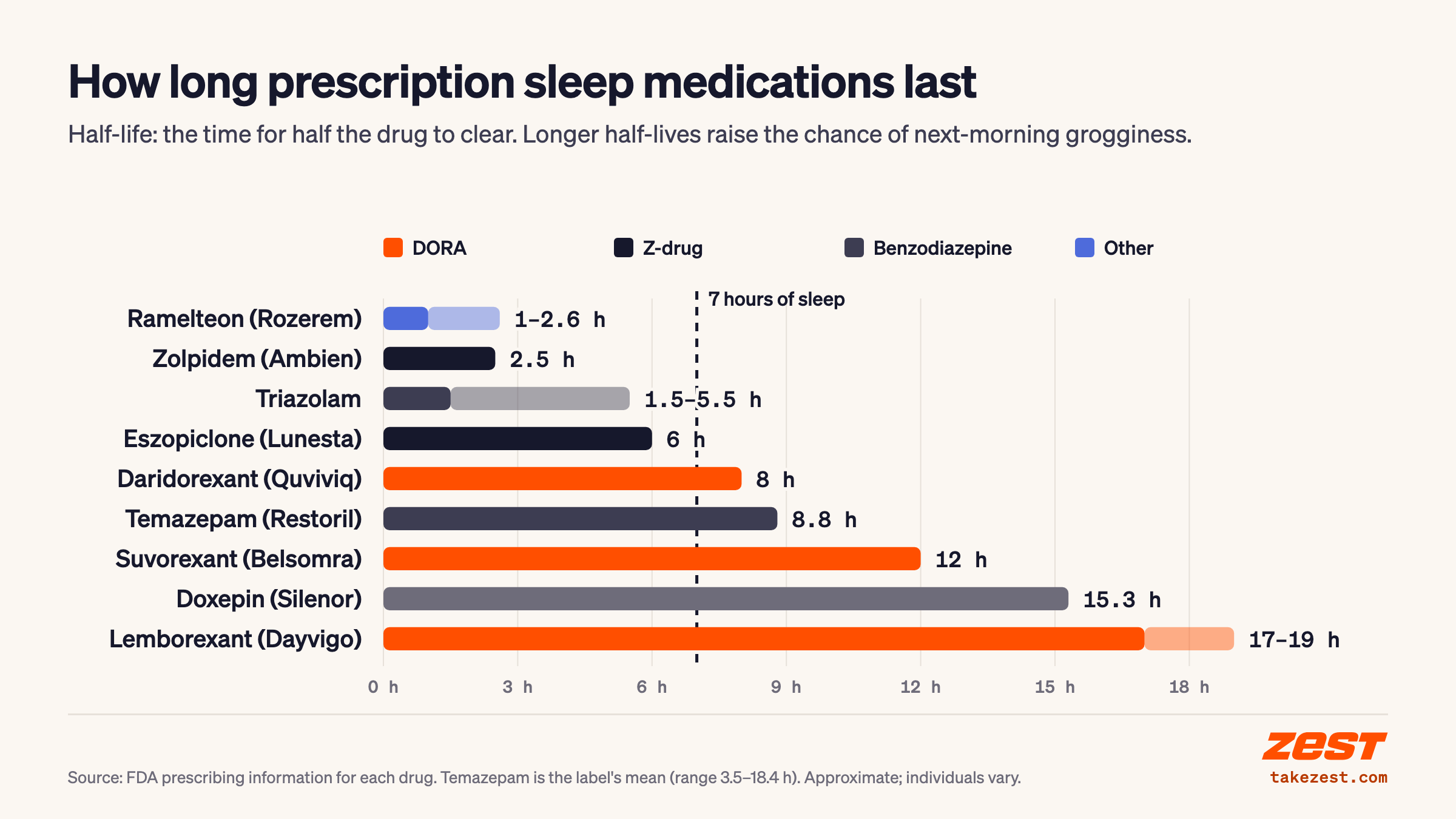
According to the FDA, all benzodiazepines bind to GABA receptors in the brain, which slows brain activity and causes drowsiness or calm. They differ mainly in how long they last. Triazolam's label lists a half-life of 1.5 to 5.5 hours; flurazepam's main active metabolite has a half-life of 47 to 100 hours. Longer-acting drugs are more likely to carry over into the next day.
Z-drugs such as zolpidem (Ambien) and eszopiclone (Lunesta) are not benzodiazepines, but they act on the same benzodiazepine receptor site. The newer DORAs work differently: they block orexin, the brain's wake signal. See our guide to DORAs and daridorexant (Quviviq).
How to take temazepam (dosage)
- The FDA label's usual adult dose is 15 mg before bed. Some people do well on 7.5 mg; others may need 30 mg.
- Older or debilitated adults should start at 7.5 mg, because the risk of oversedation, dizziness, confusion and falls rises with higher doses.
- The label's approved use is short term, generally 7 to 10 days.
- To stop or lower the dose, the label calls for a gradual taper with a patient-specific plan.
- With opioids, the label calls for lower doses and close monitoring, and it reserves the combination for people without adequate alternatives.
- Alcohol and other sedatives add to the effects.
Do benzodiazepines work? What the trials found
A 2000 meta-analysis in CMAJ pooled 45 randomized trials (2,672 patients). In sleep recordings, benzodiazepines added about 62 minutes of total sleep compared with placebo, but did not significantly shorten the time to fall asleep. More people on benzodiazepines reported side effects, especially daytime drowsiness and dizziness.
In older adults, a 2005 BMJ meta-analysis of 24 trials of sedative hypnotics (benzodiazepines and Z-drugs) found sleep improved by a small amount: about 25 more minutes a night. Adverse cognitive events were 4.78 times more common than on placebo, and the authors concluded the benefits may not justify the risk in people over 60.
The American Academy of Sleep Medicine's 2017 guideline gives temazepam and triazolam a weak recommendation for chronic insomnia compared with no treatment.
Benzodiazepine side effects
From the Restoril label's controlled studies (side effects more common on temazepam than placebo):
| Side effect | Placebo (n=783) | Restoril (n=1,076) |
|---|---|---|
| Drowsiness | 5.6% | 9.1% |
| Dizziness | 3.3% | 4.5% |
| Lethargy | 3.4% | 4.5% |
| Hangover | 1.1% | 2.5% |
| Euphoria | 0.4% | 1.5% |
| Confusion | 0.5% | 1.3% |
The bigger concerns are the warnings:
- Boxed warning (FDA, 2020). The FDA required an updated boxed warning for every benzodiazepine covering abuse, misuse, addiction, physical dependence and withdrawal. The FDA says physical dependence can develop when benzodiazepines are taken steadily for several days to weeks, even as prescribed.
- Opioids and alcohol. The boxed warning says combining benzodiazepines and opioids may cause profound sedation, slowed breathing, coma and death.
- Withdrawal. Stopping suddenly or cutting the dose fast can cause withdrawal reactions, including seizures, that can be life-threatening. Some people have symptoms for weeks to more than 12 months.
- Tolerance and rebound. The label says tolerance to some effects may develop with extended nightly use, and that after several weeks, short-acting benzodiazepines have been linked to more wakefulness late in the night and more daytime anxiety. A brief sleep disturbance was seen after stopping higher temazepam doses.
- Complex sleep behaviors such as sleep-driving, more likely with alcohol.
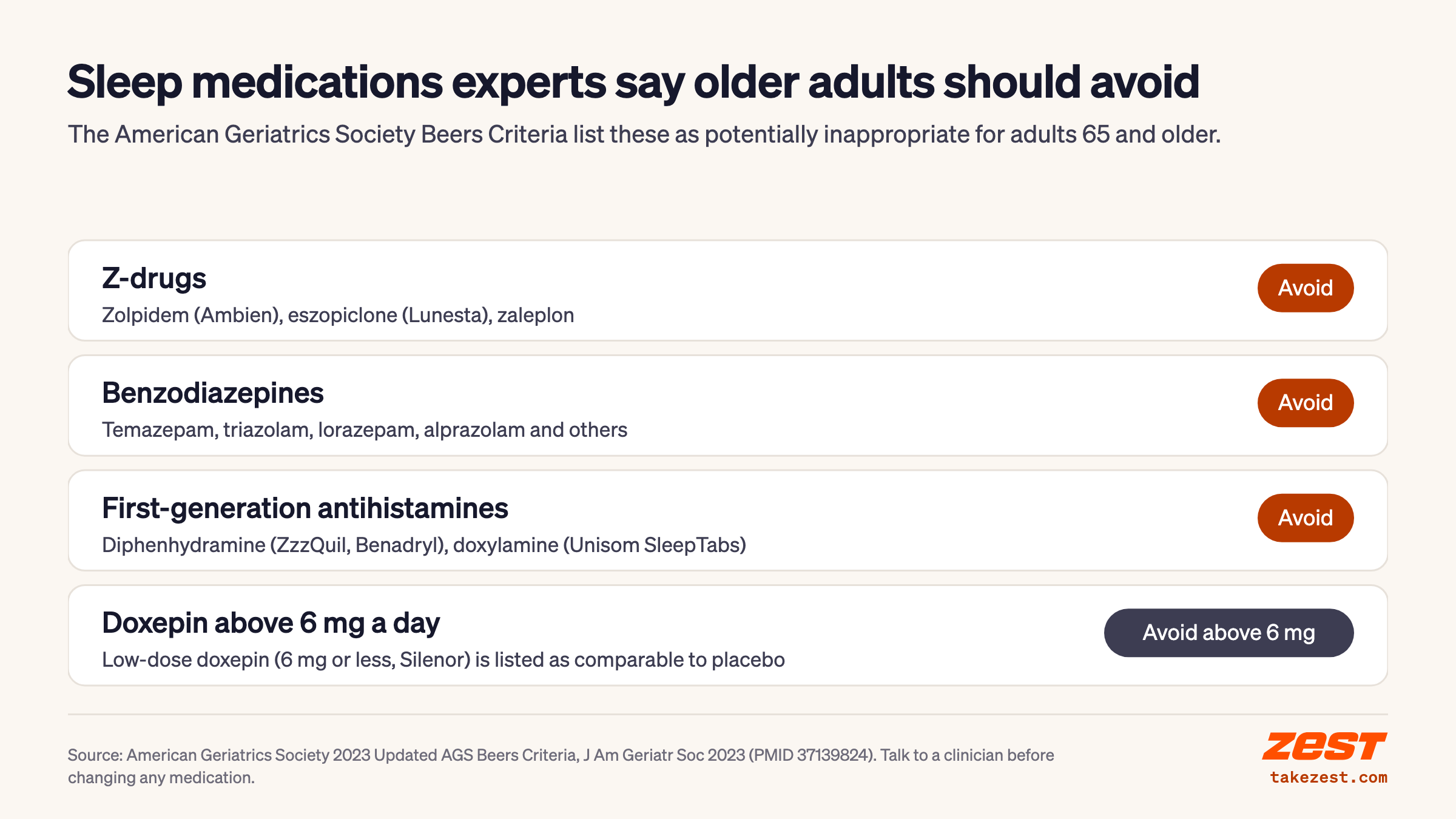
- Falls and thinking problems in older adults. The 2023 AGS Beers Criteria advise older adults to avoid benzodiazepines, saying they increase the risk of cognitive impairment, delirium, falls, fractures and motor vehicle crashes.
- Worsening depression, and sedation or withdrawal in newborns after use late in pregnancy.
Benzodiazepines vs. Z-drugs
| Temazepam (Restoril) | Zolpidem (Ambien) | Eszopiclone (Lunesta) | |
|---|---|---|---|
| Class | Benzodiazepine | Z-drug | Z-drug |
| Approved for | Short-term insomnia (7–10 days) | Short-term insomnia, trouble falling asleep | Insomnia |
| Half-life | Mean 8.8 hours | About 2.5 hours | About 6 hours |
| Controlled substance | Schedule IV | Schedule IV | Schedule IV |
| Boxed warning | Opioids; abuse and addiction; dependence and withdrawal | Complex sleep behaviors | Complex sleep behaviors |
| Beers Criteria (65+) | Avoid | Avoid | Avoid |
| Generic available | Yes | Yes | Yes |
Z-drugs are not risk-free: the Beers Criteria say their adverse events in older adults are similar to benzodiazepines', including falls, fractures and crashes. See our guides to Ambien (zolpidem) and Lunesta (eszopiclone).
Alternatives to discuss with a clinician
Cognitive behavioral therapy for insomnia (CBT-I) is the usual first step for chronic insomnia. If medication is needed, options to discuss with a clinician include the dual orexin receptor antagonists, such as Belsomra (suvorexant) and Dayvigo (lemborexant). DORAs are Schedule IV too and share warnings, including next-day impairment and complex sleep behaviors, so they are a different trade-off, not a risk-free one.
How to get a benzodiazepine prescribed
Benzodiazepines are controlled substances and need a prescription from a licensed clinician after an evaluation of your sleep, health and medications. Good sleep habits and CBT-I remain the first step; medication works best alongside them.
Zest RX for sleep. Zest is preparing to launch telehealth for sleep, connecting you with licensed providers who can evaluate whether a prescription option fits your needs. Join Zest RX early access.
Frequently asked questions
Are benzos bad for sleep?
They can help you fall and stay asleep in the short term, but they carry an FDA boxed warning for addiction, dependence and withdrawal. Tolerance can develop with nightly use, and the Beers Criteria advise older adults to avoid them because of falls and confusion.
They can help you fall and stay asleep in the short term, but they carry an FDA boxed warning for addiction, dependence and withdrawal. Tolerance can develop with nightly use, and the Beers Criteria advise older adults to avoid them because of falls and confusion.
Is temazepam a controlled substance?
Yes. Temazepam is a DEA Schedule IV controlled substance, like the other benzodiazepines and the Z-drugs. It needs a prescription, and the label warns that selling or sharing it is illegal and can harm others.
Yes. Temazepam is a DEA Schedule IV controlled substance, like the other benzodiazepines and the Z-drugs. It needs a prescription, and the label warns that selling or sharing it is illegal and can harm others.
How long does temazepam stay in your system?
The FDA label lists a terminal half-life of 3.5 to 18.4 hours, with a mean of 8.8 hours. That range means some people may still feel effects the next morning.
The FDA label lists a terminal half-life of 3.5 to 18.4 hours, with a mean of 8.8 hours. That range means some people may still feel effects the next morning.
Benzodiazepines vs. Z-drugs: which is safer?
Neither class is risk-free. Benzodiazepines carry a boxed warning for addiction, dependence and withdrawal; Z-drugs carry one for complex sleep behaviors. The Beers Criteria advise older adults to avoid both. Which fits, if any, is a decision for your clinician.
Neither class is risk-free. Benzodiazepines carry a boxed warning for addiction, dependence and withdrawal; Z-drugs carry one for complex sleep behaviors. The Beers Criteria advise older adults to avoid both. Which fits, if any, is a decision for your clinician.
Can you take a benzodiazepine with alcohol?
No. The label says alcohol adds to the sedation, raises the risk of sleep-driving, and is commonly involved in serious outcomes from misuse. Combining benzodiazepines with opioids can cause dangerously slowed breathing and death.
No. The label says alcohol adds to the sedation, raises the risk of sleep-driving, and is commonly involved in serious outcomes from misuse. Combining benzodiazepines with opioids can cause dangerously slowed breathing and death.
Is there a generic for Restoril?
Yes. Several generic temazepam capsules are approved, according to the FDA's Drugs@FDA database. Generic triazolam, estazolam and flurazepam are approved too; quazepam (Doral) has no approved generic.
Yes. Several generic temazepam capsules are approved, according to the FDA's Drugs@FDA database. Generic triazolam, estazolam and flurazepam are approved too; quazepam (Doral) has no approved generic.
Sources
- RESTORIL (temazepam) prescribing information and Medication Guide. DailyMed
- FDA. FDA requiring Boxed Warning updated to improve safe use of benzodiazepine drug class. Drug Safety Communication, September 23, 2020. FDA
- 2023 American Geriatrics Society Beers Criteria Update Expert Panel. American Geriatrics Society 2023 updated AGS Beers Criteria for potentially inappropriate medication use in older adults. J Am Geriatr Soc. 2023;71(7):2052-2081. PubMed
- Sateia MJ, et al. Clinical Practice Guideline for the Pharmacologic Treatment of Chronic Insomnia in Adults: An American Academy of Sleep Medicine Clinical Practice Guideline. J Clin Sleep Med. 2017;13(2):307-349. PubMed
- Holbrook AM, et al. Meta-analysis of benzodiazepine use in the treatment of insomnia. CMAJ. 2000;162(2):225-233. PubMed
- Glass J, et al. Sedative hypnotics in older people with insomnia: meta-analysis of risks and benefits. BMJ. 2005;331(7526):1169. PubMed
- AMBIEN (zolpidem) prescribing information. DailyMed
- LUNESTA (eszopiclone) prescribing information. DailyMed
SLEEP
INSOMNIA
SLEEP MEDICATION