
SLEEP
Orzeyful (Oveporexton) and Orexin Agonists: The New Narcolepsy Drugs
Orzeyful (oveporexton) is the first approved orexin agonist. How orexin agonists work, what the trials showed, side effects, and what's still in development.

The Zest Team
· 5 min read
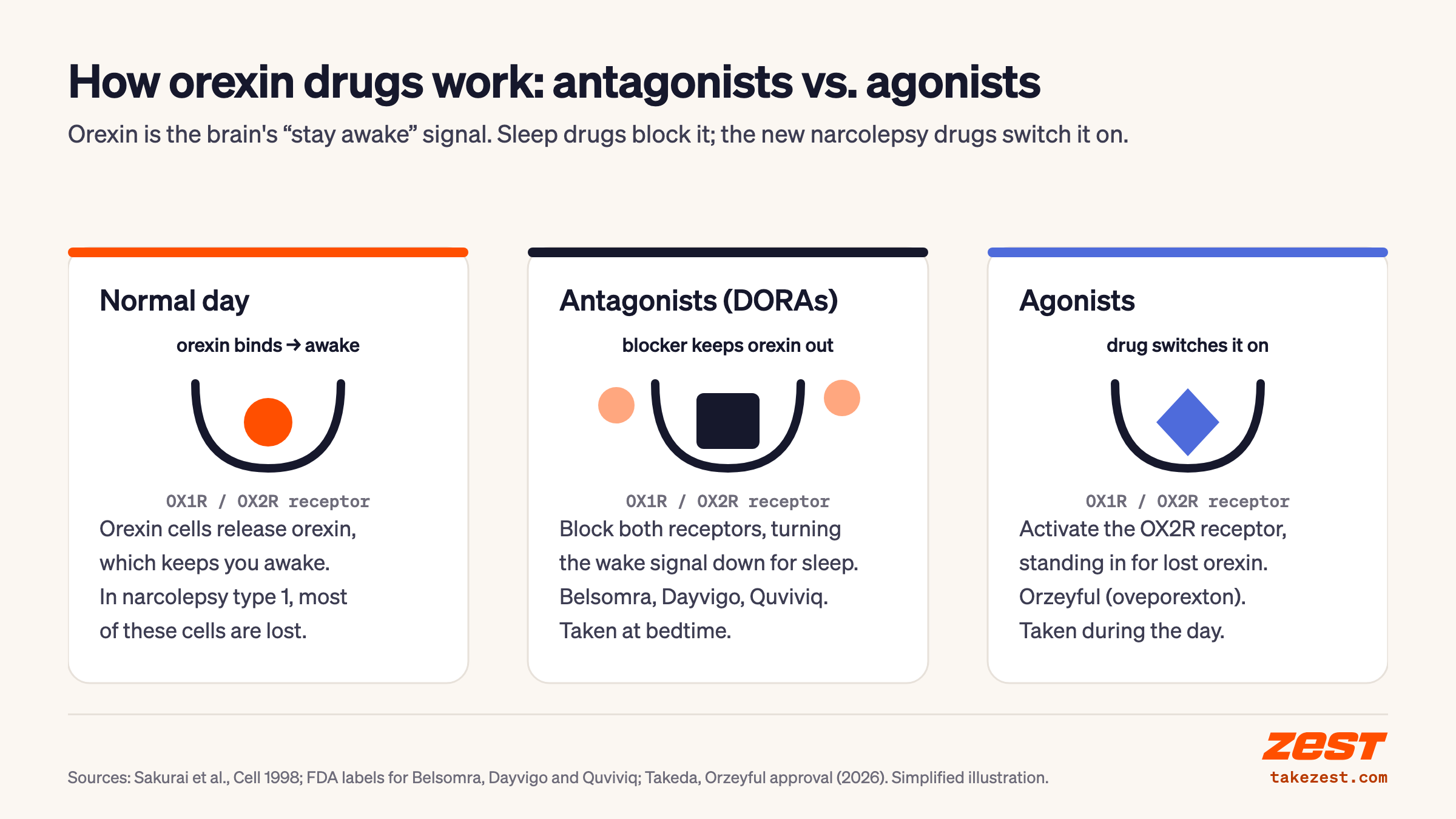
Orexin agonists are a new class of medicines that switch on the brain's orexin "stay awake" signal. They are the opposite of the orexin-blocking sleep pills (DORAs). The first one, oveporexton, sold as Orzeyful by Takeda, was approved by the FDA on August 5, 2026 for adults with narcolepsy type 1, and it launched in the U.S. in November 2026.
Here is what orexin does, how agonists work, what the trials of Orzeyful showed, its side effects, and the other orexin agonists still in development. This is educational information, not medical advice.
What is orexin?
Orexin, also called hypocretin, is a pair of signaling molecules made by a small cluster of brain cells in the hypothalamus. Two research groups discovered it independently in 1998, and it acts on two receptors, OX1R and OX2R. Orexin holds the brain in a stable awake state during the day and falls away at night.
Its importance became clear from narcolepsy. In 2000, two studies of human brain tissue found that people with narcolepsy have lost most of their orexin-producing cells. That loss is what defines narcolepsy type 1 (narcolepsy with cataplexy, the sudden muscle weakness triggered by strong emotion).
Orexin agonists vs. orexin antagonists
| Orexin agonists | Orexin antagonists (DORAs) | |
|---|---|---|
| What they do | Switch the orexin wake signal on | Block the orexin wake signal |
| Used for | Narcolepsy type 1 (Orzeyful); others in trials for narcolepsy type 2 and idiopathic hypersomnia | Trouble falling or staying asleep |
| Examples | Oveporexton (Orzeyful); alixorexton and cleminorexton (investigational) | Suvorexant (Belsomra), lemborexant (Dayvigo), daridorexant (Quviviq) |
| Taken | In the morning and daytime | At bedtime |
Notably, all three DORAs carry a warning against use in people with narcolepsy, the exact group orexin agonists are built for. For the sleep side of this story, see our guides to daridorexant (Quviviq) and DORAs, Belsomra and Dayvigo.
Orzeyful (oveporexton): the first approved orexin agonist
| Generic name | Oveporexton (TAK-861) |
|---|---|
| Brand name | Orzeyful (Takeda) |
| How it works | Selective orexin 2 receptor (OX2R) agonist |
| FDA approval | August 5, 2026, for adults with narcolepsy type 1 |
| Other approvals | China (July 2026, ages 16 and up) and Japan (August 2026) |
| Controlled substance | Yes, DEA Schedule IV (November 2026) |
| U.S. launch | November 12, 2026, through a specialty pharmacy |
| Dosing studied | 1 mg or 2 mg tablets, twice a day |
What the Orzeyful trials showed
Two 12-week phase 3 trials, FirstLight and RadiantLight, were published in the New England Journal of Medicine in September 2026. They enrolled 273 people with narcolepsy type 1 aged 16 to 70, and every main goal was met:
- Staying awake: on the Maintenance of Wakefulness Test, a lab test of how long you can stay awake in a quiet, dim room, time awake rose by about 14–20 minutes on oveporexton, against essentially no change on placebo.
- Daytime sleepiness: scores on the Epworth Sleepiness Scale fell by about 10–12 points, against about 2 points on placebo.
- Cataplexy: weekly attacks fell by a median of about 79–89%, against 28–39% on placebo.
An earlier 8-week phase 2 trial in 112 people, also in the NEJM (2025), found similar gains and no liver problems. That mattered, because an earlier Takeda orexin agonist, TAK-994, was stopped in 2023 after it caused liver injury in trial participants.
Orzeyful side effects
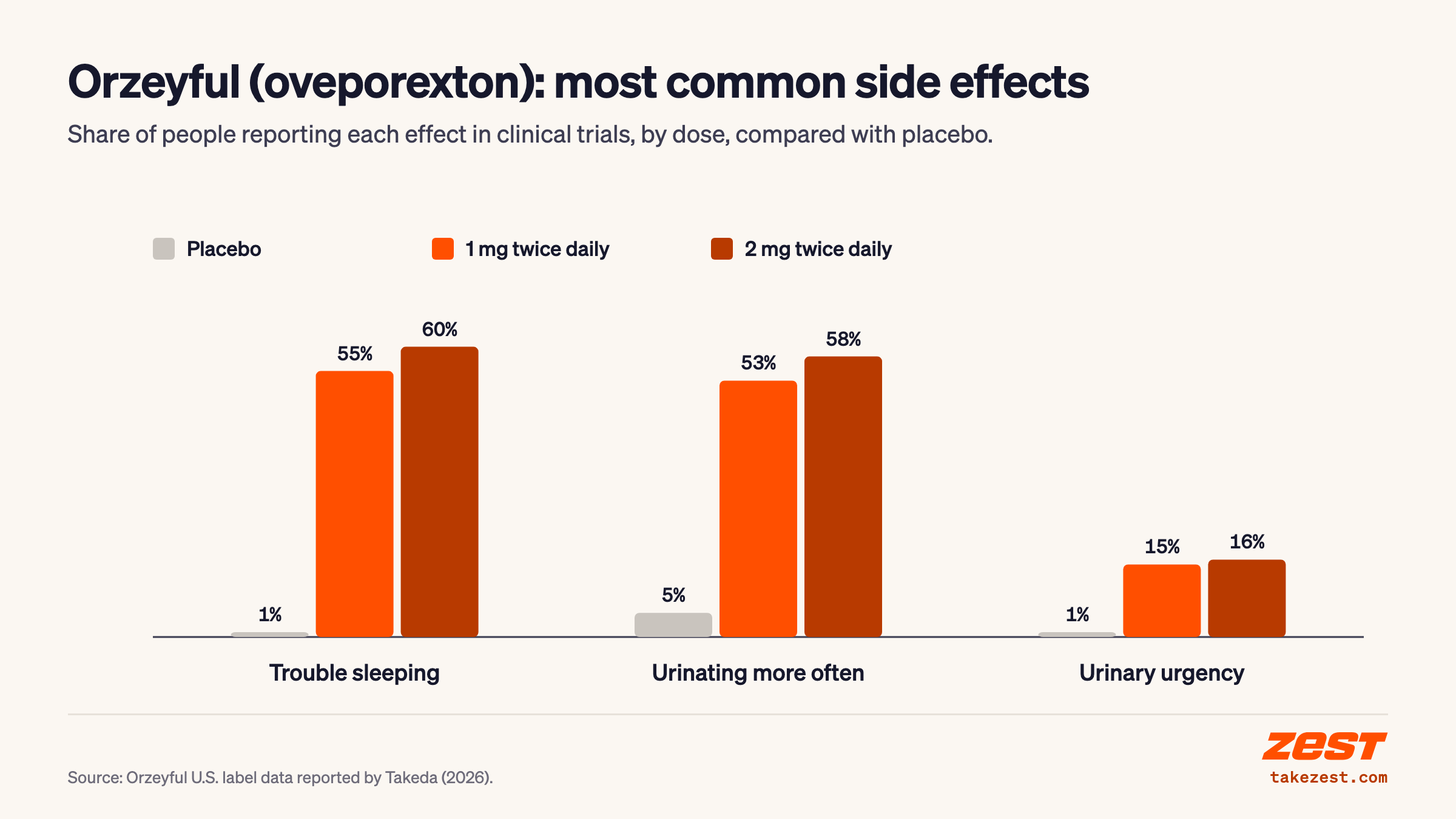
Waking the orexin system up has predictable effects. From the U.S. label data Takeda reported:
| Side effect | Placebo | 1 mg twice daily | 2 mg twice daily |
|---|---|---|---|
| Trouble sleeping | 1% | 55% | 60% |
| Needing to urinate more often | 5% | 53% | 58% |
| Urinary urgency | 1% | 15% | 16% |
Extra saliva is also among the most common effects. In the trials the trouble sleeping was usually short-lived. The label also notes raised levels of the muscle enzyme CPK without symptoms (11% versus 5% on placebo), a warning about misuse, and that it should not be taken with strong CYP3A inhibitors.
Other orexin agonists in development
- Alixorexton (ALKS 2680, Alkermes): a once-daily OX2R agonist. In the phase 2 Vibrance-1 trial in narcolepsy type 1 (Lancet Neurology, 2026), wakefulness test times improved by about 22–26 minutes over placebo after six weeks. Common effects included urinating more often, trouble sleeping, extra saliva and, in 14% of people, blurred vision. A phase 2 trial in narcolepsy type 2 was also positive, and phase 3 trials began in 2026.
- Cleminorexton (formerly ORX750): developed by Centessa, which Eli Lilly acquired in June 2026. Early, company-reported results from a small phase 2a study covered narcolepsy types 1 and 2 and idiopathic hypersomnia, and a phase 2/3 study began in 2026. No peer-reviewed results yet.
- Others: Takeda's TAK-360 and Eisai's E2086 are in phase 2 trials.
None of these is approved for narcolepsy type 2 or idiopathic hypersomnia yet, and orexin agonists have not been shown to help ordinary tiredness in people without these conditions.
Who are orexin agonists for?
Right now, Orzeyful is for adults diagnosed with narcolepsy type 1, usually through a sleep specialist after an overnight sleep study and a daytime nap test. If you are sleepy all day despite a full night's sleep, falling asleep at the wrong moments, or having episodes of sudden weakness with laughter or surprise, that is worth raising with a doctor or a sleep clinic.
Frequently asked questions
Is Orzeyful approved by the FDA?
Yes. The FDA approved Orzeyful (oveporexton) on August 5, 2026 for adults with narcolepsy type 1. It became available in the U.S. on November 12, 2026.
Yes. The FDA approved Orzeyful (oveporexton) on August 5, 2026 for adults with narcolepsy type 1. It became available in the U.S. on November 12, 2026.
What is the difference between an orexin agonist and an orexin antagonist?
An agonist switches the orexin wake signal on and is taken in the daytime for narcolepsy. An antagonist, such as Belsomra or Quviviq, blocks it and is taken at bedtime for trouble sleeping.
An agonist switches the orexin wake signal on and is taken in the daytime for narcolepsy. An antagonist, such as Belsomra or Quviviq, blocks it and is taken at bedtime for trouble sleeping.
What are the side effects of Orzeyful?
The most common are trouble sleeping, needing to urinate more often, urinary urgency and extra saliva. In the label data, trouble sleeping affected 55–60% of people versus 1% on placebo.
The most common are trouble sleeping, needing to urinate more often, urinary urgency and extra saliva. In the label data, trouble sleeping affected 55–60% of people versus 1% on placebo.
Is oveporexton a controlled substance?
Yes. The DEA placed oveporexton in Schedule IV in November 2026, the same schedule as the DORA sleep medications.
Yes. The DEA placed oveporexton in Schedule IV in November 2026, the same schedule as the DORA sleep medications.
Can orexin agonists help narcolepsy type 2?
Not yet. Orzeyful is approved only for narcolepsy type 1. Alixorexton and cleminorexton are being tested in narcolepsy type 2 and idiopathic hypersomnia, and phase 3 trials are still under way.
Not yet. Orzeyful is approved only for narcolepsy type 1. Alixorexton and cleminorexton are being tested in narcolepsy type 2 and idiopathic hypersomnia, and phase 3 trials are still under way.
Will orexin agonists work for normal tiredness?
There is no evidence for that. They are developed and tested for conditions where the orexin system is damaged or underactive, not for everyday fatigue.
There is no evidence for that. They are developed and tested for conditions where the orexin system is damaged or underactive, not for everyday fatigue.
Sources
- Dauvilliers Y, et al. Oveporexton for Narcolepsy Type 1: Results from Two Phase 3 Trials. N Engl J Med. 2026. PubMed
- Dauvilliers Y, et al. Oveporexton, an Oral Orexin Receptor 2-Selective Agonist, in Narcolepsy Type 1. N Engl J Med. 2025. PubMed
- Dauvilliers Y, et al. Oral Orexin Receptor 2 Agonist in Narcolepsy Type 1. N Engl J Med. 2023 (TAK-994). PubMed
- Plazzi G, et al. Safety, tolerability, and efficacy of alixorexton (Vibrance-1). Lancet Neurol. 2026. PubMed
- Brown MB. Oveporexton: First Approval. Drugs. 2026. PubMed
- Sakurai T, et al. Orexins and orexin receptors. Cell. 1998. PubMed
- American Academy of Sleep Medicine. FDA approves Orzeyful for narcolepsy type 1 in adults. AASM
SLEEP
SLEEP MEDICATION