SLEEP
Prescription Sleep Medications: A Class-by-Class Guide to Insomnia Drugs and Their Risks
Insomnia medications come in several classes that work differently and carry different risks. This guide compares DORAs, Z-drugs, benzodiazepines, ramelteon, low-dose doxepin, off-label trazodone and OTC antihistamines, with the FDA boxed warnings, Beers Criteria and what the AASM recommends.

The Zest Team
· 8 min read
Prescription sleep medication for insomnia comes in several drug classes: orexin receptor antagonists (DORAs), Z-drugs such as Ambien, benzodiazepines, the melatonin receptor agonist ramelteon, and low-dose doxepin. Trazodone is also prescribed off-label, and antihistamines are sold over the counter. They work in different ways and carry different risks, and none is the best choice for everyone.
This guide walks through each class: how it works, examples, whether it is a controlled substance, and its main concerns, plus what the American Academy of Sleep Medicine (AASM) says about it. This is educational information, not medical advice; talk to a licensed clinician before starting or stopping any medication.
Sleep medications at a glance
| Class | How it works | Examples | Controlled? | Main concerns |
|---|---|---|---|---|
| DORAs (orexin receptor antagonists) | Block the orexin wake signal | Suvorexant (Belsomra), lemborexant (Dayvigo), daridorexant (Quviviq) | Schedule IV | Next-day sleepiness, complex sleep behaviors, not for narcolepsy |
| Z-drugs | Boost GABA, the brain's main brake | Zolpidem (Ambien), eszopiclone (Lunesta), zaleplon (Sonata) | Schedule IV | Boxed warning for complex sleep behaviors; next-morning impairment; on the Beers list for older adults |
| Benzodiazepines | Boost GABA | Temazepam (Restoril), triazolam | Schedule IV | Boxed warning for abuse, dependence and withdrawal, and with opioids; on the Beers list |
| Melatonin receptor agonist | Acts on melatonin MT1 and MT2 receptors | Ramelteon (Rozerem) | No | Approved only for trouble falling asleep |
| Low-dose doxepin | Blocks histamine H1 receptors | Doxepin 3 or 6 mg (Silenor) | No | Approved only for trouble staying asleep; next-day impairment, complex behaviors |
| Trazodone (off-label) | Antidepressant acting on serotonin | Trazodone | No | Not FDA-approved for insomnia; AASM suggests against it for insomnia |
| OTC antihistamines | Block histamine H1 receptors (anticholinergic) | Diphenhydramine (ZzzQuil), doxylamine (Unisom SleepTabs) | No (over the counter) | For occasional sleeplessness only; AASM suggests against diphenhydramine; on the Beers list |
What the AASM guidelines say
Medication is usually not the first step. The AASM's 2021 guideline on behavioral treatments makes a strong recommendation for cognitive behavioral therapy for insomnia (CBT-I) in adults with chronic insomnia. CBT-I is a structured program that retrains sleep habits and the thoughts that keep you awake.
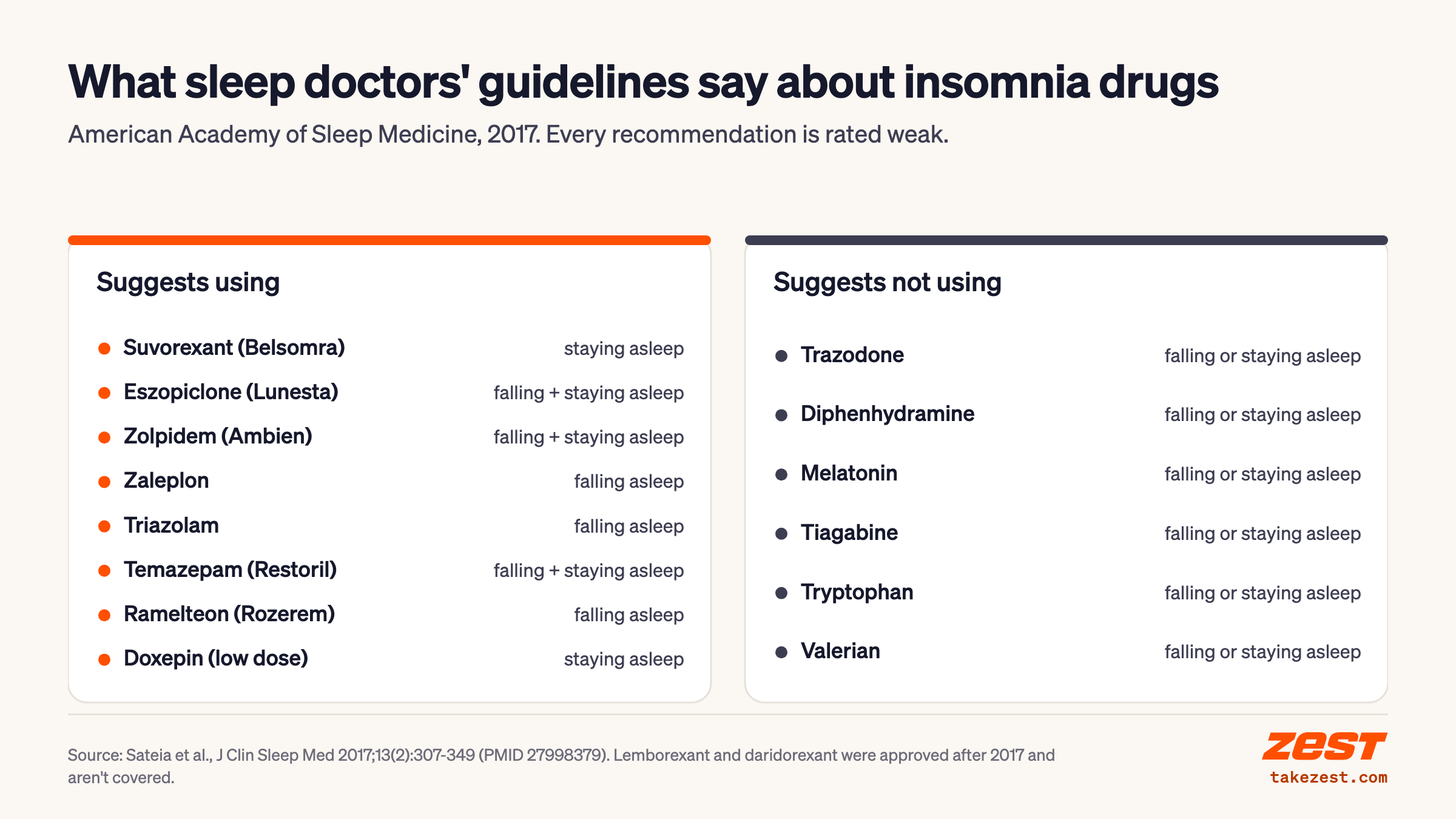
For drugs, the AASM's 2017 pharmacologic guideline (Sateia et al.) reviewed individual medicines. It suggested suvorexant, eszopiclone, zaleplon, zolpidem, triazolam, temazepam, ramelteon and doxepin as options for specific insomnia patterns, and suggested clinicians not use trazodone or diphenhydramine for insomnia. Every one of those recommendations was rated weak, reflecting limited certainty in the evidence. Lemborexant and daridorexant were approved after it was published, so it does not cover them.
DORAs: suvorexant, lemborexant, daridorexant
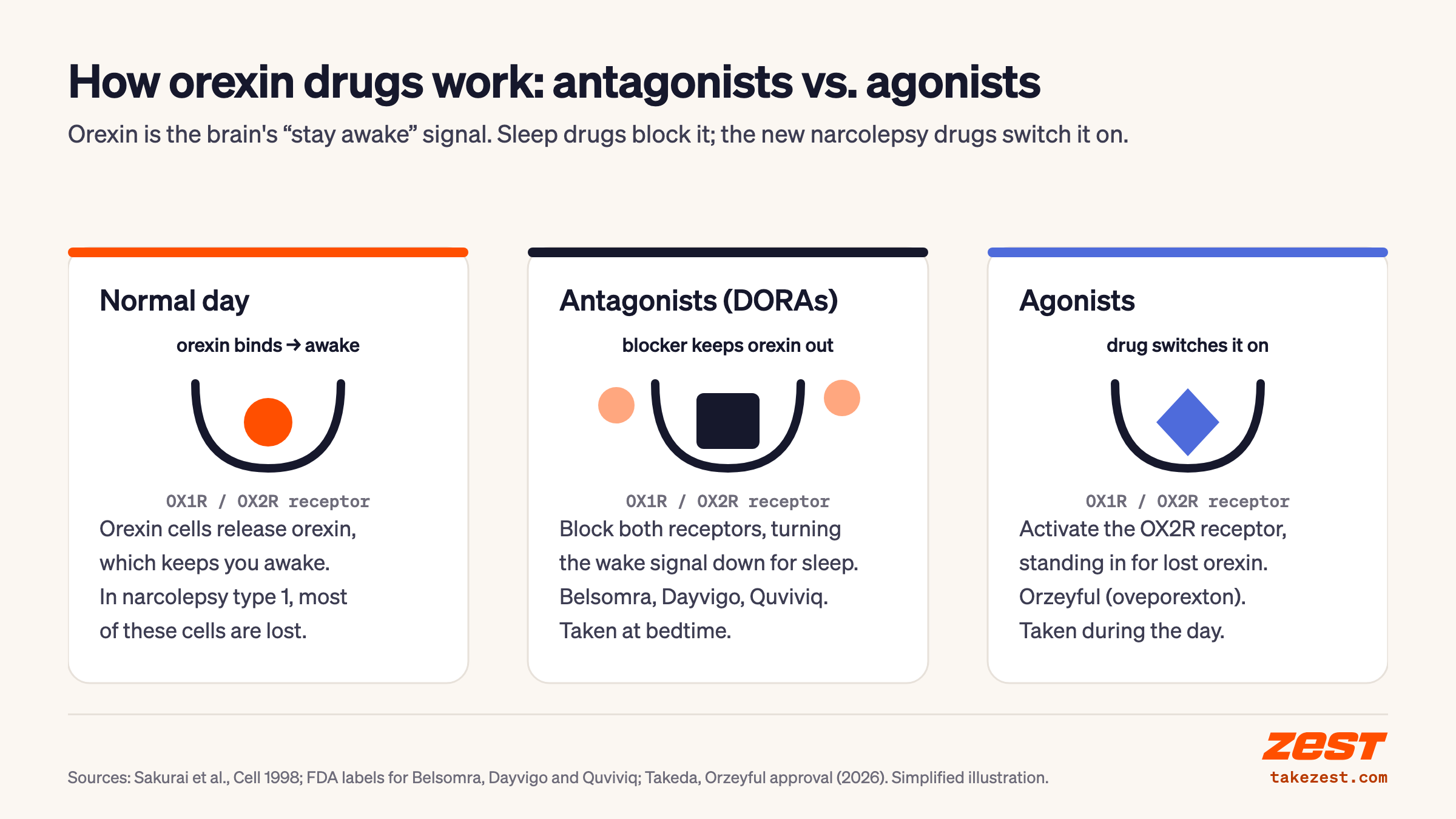
Dual orexin receptor antagonists are the newest insomnia medications. Belsomra (2014), Dayvigo (2019) and Quviviq (2022) block orexin, the signal that holds you awake, instead of sedating the brain broadly. They are approved for trouble falling and/or staying asleep and are Schedule IV.
They are not risk-free. Their labels warn about next-day impairment, complex sleep behaviors such as sleep-walking, sleep paralysis and worsening depression, and they should not be used by people with narcolepsy. See our guides to daridorexant (Quviviq) and DORAs, Belsomra (suvorexant) and Dayvigo (lemborexant).
Z-drugs: Ambien, Lunesta and their risks
Zolpidem (Ambien), eszopiclone (Lunesta) and zaleplon act on GABA receptors. Ambien is FDA-approved for short-term treatment of trouble falling asleep, and they can help some people in the short term. But sleep specialists have grown more cautious about them, for documented reasons:
- Boxed warning. In 2019 the FDA added a boxed warning, its most prominent, after reports of serious injuries and deaths from complex sleep behaviors such as sleep-walking and sleep-driving while not fully awake. Anyone who has had such an episode should not take these drugs again.
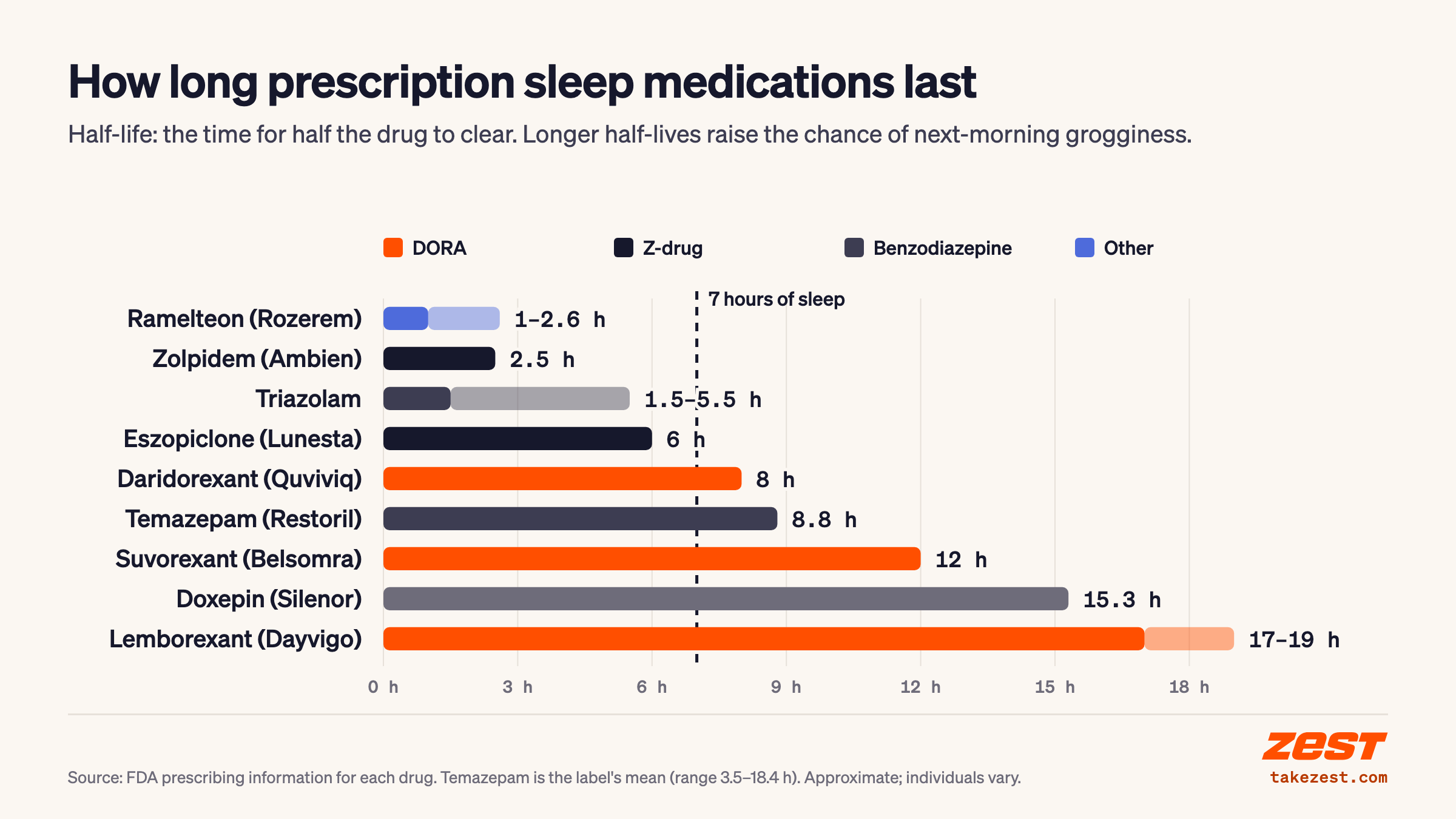
- Next-morning impairment. The labels warn that alertness and coordination can be impaired the next morning, with higher risk at higher doses or with alcohol. Ambien's recommended starting dose is 5 mg for women and 5 or 10 mg for men.
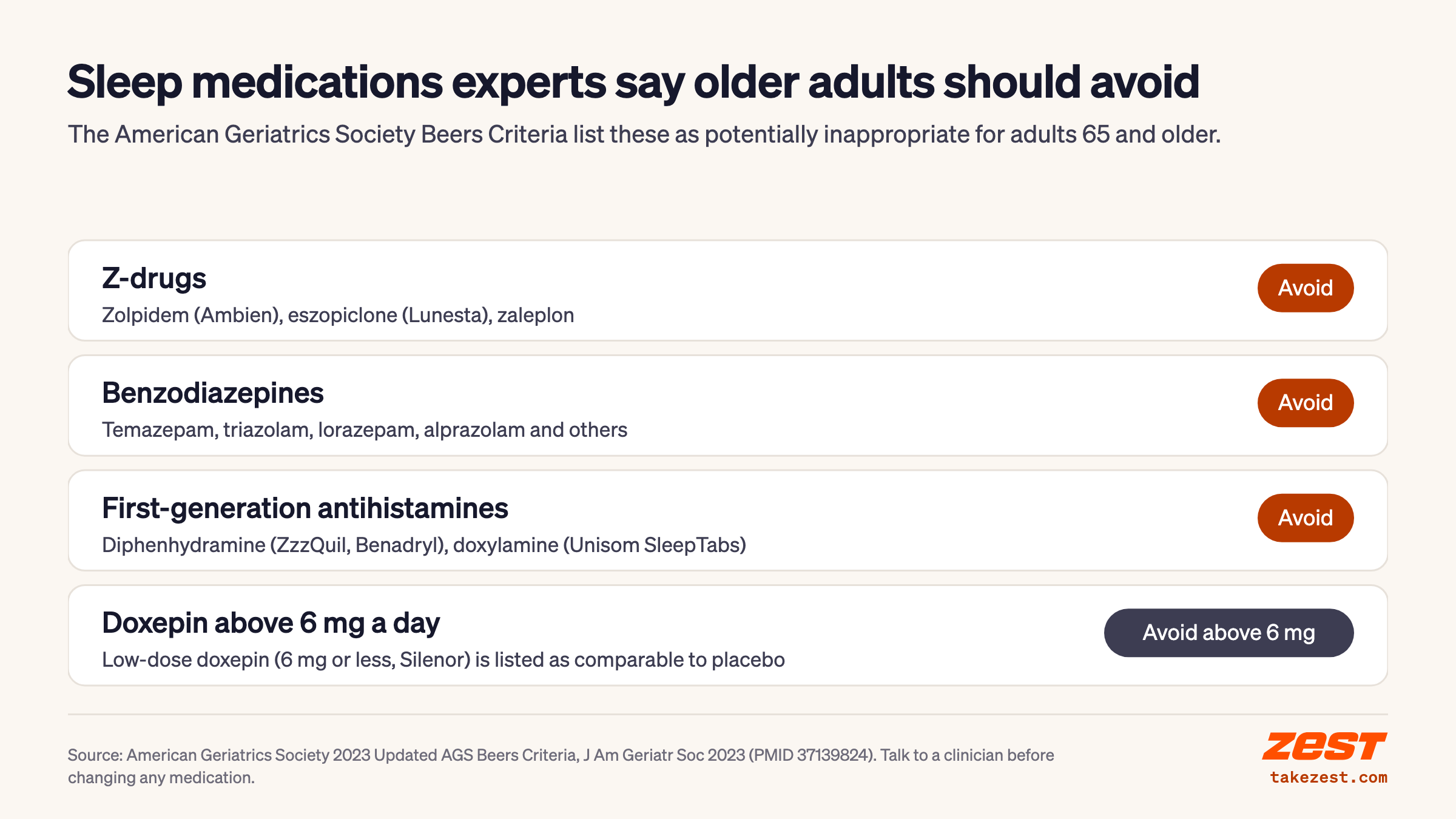
- Older adults. The 2023 AGS Beers Criteria advise avoiding Z-drugs in adults 65 and older, citing delirium, falls, fractures and motor vehicle crashes, with minimal improvement in sleep.
Read more in our guides to Ambien (zolpidem) and Lunesta (eszopiclone).
Benzodiazepines for sleep
Temazepam (Restoril) and triazolam are benzodiazepines approved for insomnia. Their labels limit them to short-term use, generally 7 to 10 days. The concerns are well established:
- Boxed warning. In 2020 the FDA required the boxed warning for all benzodiazepines to cover abuse, misuse, addiction, physical dependence and withdrawal reactions. It also warns that combining them with opioids can cause profound sedation, slowed breathing, coma and death.
- Older adults. The Beers Criteria advise avoiding benzodiazepines, which raise the risk of cognitive impairment, delirium, falls, fractures and crashes in older adults.
Don't stop a sleep medication suddenly, especially a benzodiazepine; withdrawal can be serious. Talk to your prescriber about tapering. More in our guide to benzodiazepines for sleep.
Ramelteon (Rozerem)
Ramelteon acts on the same receptors as your body's melatonin. It is approved for trouble falling asleep, not staying asleep. Its label says it is not a controlled substance and that stopping it did not produce withdrawal signs in studies. AASM gave it a weak recommendation for sleep onset. See our Rozerem (ramelteon) guide.
Low-dose doxepin (Silenor)
Doxepin is an old antidepressant. At 3 or 6 mg, as Silenor, it is FDA-approved for trouble staying asleep and appears to work by blocking histamine. It is not a controlled substance. The Beers Criteria treat it differently from higher doses: they advise older adults to avoid doxepin above 6 mg a day, but note that the safety of 6 mg or less is comparable to placebo. Its label still warns about next-day impairment, complex behaviors and worsening depression. See our guide to doxepin for sleep.
Trazodone (off-label)
Trazodone is FDA-approved for major depressive disorder in adults. Using it for sleep is off-label: it has never been approved for insomnia, and the AASM 2017 guideline suggests clinicians not use it for that purpose. Like other antidepressants, its label carries a boxed warning about suicidal thoughts in children and young adults. Read more in our trazodone for sleep guide.
Over-the-counter antihistamine sleep aids
Diphenhydramine (the 50 mg in ZzzQuil) and doxylamine (the 25 mg in Unisom SleepTabs) are first-generation antihistamines. Their Drug Facts labels allow them for occasional sleeplessness, and say to stop and ask a doctor if sleeplessness lasts more than two weeks. Even without a prescription, they have downsides:
- The AASM suggests clinicians not use diphenhydramine for insomnia.
- The Beers Criteria advise older adults to avoid them: they are highly anticholinergic, tolerance develops when they are used for sleep, and they can cause confusion, dry mouth and constipation.
- A 2015 study of 3,434 adults 65 and older linked the highest cumulative use of strong anticholinergic drugs, including first-generation antihistamines, with a higher risk of dementia. That is an association, not proof that the drugs cause dementia.
See our guide to antihistamine sleep aids.
Which sleep medication is right for you?
There is no single best prescription sleep aid. The right option depends on whether you struggle to fall asleep or stay asleep, your age, other conditions such as sleep apnea or depression, other medicines, and your history with alcohol or sedatives. If you want something non-habit-forming, ramelteon, low-dose doxepin and trazodone are not controlled substances, but each has its own limits. These are options to discuss with a clinician, ideally alongside CBT-I. If your main problem is sleepiness during the day rather than trouble sleeping at night, that calls for a different evaluation; see our guide to modafinil and armodafinil.
How to get a prescription sleep medication
All of these except the OTC antihistamines need a prescription from a licensed clinician after an evaluation of your sleep, health and medications. Insomnia can be a sign of another problem, such as sleep apnea, depression or a medication side effect. Good sleep habits and CBT-I come first.
Zest RX for sleep. Zest is preparing to launch telehealth for sleep, connecting you with licensed providers who can evaluate whether a prescription option fits your needs. Join Zest RX early access.
Frequently asked questions
What is the best prescription sleep aid?
There isn't one for everyone. AASM rated all its drug recommendations as weak, and the right choice depends on your sleep pattern, age, health and other medicines. CBT-I is strongly recommended first for chronic insomnia.
There isn't one for everyone. AASM rated all its drug recommendations as weak, and the right choice depends on your sleep pattern, age, health and other medicines. CBT-I is strongly recommended first for chronic insomnia.
Is there a non-habit-forming sleep medication?
Ramelteon (Rozerem), low-dose doxepin (Silenor) and trazodone are not controlled substances. DORAs, Z-drugs and benzodiazepines are Schedule IV. Not controlled does not mean risk-free, so discuss the trade-offs with a clinician.
Ramelteon (Rozerem), low-dose doxepin (Silenor) and trazodone are not controlled substances. DORAs, Z-drugs and benzodiazepines are Schedule IV. Not controlled does not mean risk-free, so discuss the trade-offs with a clinician.
What are the new insomnia medications?
The newest are DORAs: suvorexant (Belsomra, 2014), lemborexant (Dayvigo, 2019) and daridorexant (Quviviq, 2022). They block the orexin wake signal rather than sedating the brain, but still carry warnings about next-day impairment and complex sleep behaviors.
The newest are DORAs: suvorexant (Belsomra, 2014), lemborexant (Dayvigo, 2019) and daridorexant (Quviviq, 2022). They block the orexin wake signal rather than sedating the brain, but still carry warnings about next-day impairment and complex sleep behaviors.
Is Ambien a controlled substance?
Yes. Zolpidem is Schedule IV, like eszopiclone, the benzodiazepines and the DORAs. Since 2019 it has carried a boxed warning for complex sleep behaviors such as sleep-walking and sleep-driving.
Yes. Zolpidem is Schedule IV, like eszopiclone, the benzodiazepines and the DORAs. Since 2019 it has carried a boxed warning for complex sleep behaviors such as sleep-walking and sleep-driving.
Is trazodone approved for sleep?
No. Trazodone is approved for major depressive disorder. Prescribing it for insomnia is off-label, and the AASM's 2017 guideline suggests clinicians not use it as an insomnia treatment.
No. Trazodone is approved for major depressive disorder. Prescribing it for insomnia is off-label, and the AASM's 2017 guideline suggests clinicians not use it as an insomnia treatment.
Are over-the-counter sleep aids safe for older adults?
The 2023 Beers Criteria advise adults 65 and older to avoid first-generation antihistamines such as diphenhydramine and doxylamine because they are highly anticholinergic and can cause confusion. Ask a clinician or pharmacist before using them.
The 2023 Beers Criteria advise adults 65 and older to avoid first-generation antihistamines such as diphenhydramine and doxylamine because they are highly anticholinergic and can cause confusion. Ask a clinician or pharmacist before using them.
Sources
- Sateia MJ, et al. Clinical Practice Guideline for the Pharmacologic Treatment of Chronic Insomnia in Adults: An American Academy of Sleep Medicine Clinical Practice Guideline. J Clin Sleep Med. 2017;13(2):307-349. PubMed
- Edinger JD, et al. Behavioral and psychological treatments for chronic insomnia disorder in adults: an American Academy of Sleep Medicine clinical practice guideline. J Clin Sleep Med. 2021;17(2):255-262. PubMed
- American Geriatrics Society 2023 updated AGS Beers Criteria for potentially inappropriate medication use in older adults. J Am Geriatr Soc. 2023;71(7):2052-2081. PubMed
- Gray SL, et al. Cumulative use of strong anticholinergics and incident dementia: a prospective cohort study. JAMA Intern Med. 2015;175(3):401-407. PubMed
- FDA. Certain prescription insomnia medicines: new Boxed Warning due to risk of serious injuries caused by sleepwalking, sleep driving and engaging in other activities while not fully awake (2019). FDA
- FDA. FDA requiring Boxed Warning updated to improve safe use of benzodiazepine drug class (2020). FDA
- AMBIEN (zolpidem) prescribing information. DailyMed
- LUNESTA (eszopiclone) prescribing information. DailyMed
- RESTORIL (temazepam) prescribing information. DailyMed
- ROZEREM (ramelteon) prescribing information. DailyMed
- SILENOR (doxepin) prescribing information. DailyMed
- Triazolam tablets prescribing information. DailyMed
- Trazodone hydrochloride tablets prescribing information. DailyMed
- BELSOMRA (suvorexant) prescribing information. DailyMed
- DAYVIGO (lemborexant) prescribing information. DailyMed
- QUVIVIQ (daridorexant) prescribing information. DailyMed
- Vicks ZzzQuil Nighttime Sleep-Aid (diphenhydramine) Drug Facts. DailyMed
- Unisom SleepTabs (doxylamine) Drug Facts. DailyMed
SLEEP
INSOMNIA
SLEEP MEDICATION