SLEEP
Trazodone for Sleep: Off-Label Use, Dosage, Side Effects and Risks
Trazodone is FDA-approved only for depression, so using it for sleep is off-label. Here is what the label says, what the insomnia research and the AASM guideline found, its side effects and boxed warning, and how it compares with Ambien.

The Zest Team
· 6 min read
Trazodone is a prescription antidepressant, first sold as Desyrel and now available as a generic from many manufacturers. The FDA approved it in 1981 for major depressive disorder in adults. It is not FDA-approved for insomnia: using trazodone for sleep is off-label, meaning a clinician prescribes it for a use the FDA has not reviewed. The label describes it as both a serotonin reuptake inhibitor and a 5-HT2 receptor blocker.
Here is what the label says, what the sleep research and guidelines found, its warnings, and how it compares with Ambien. This is educational information, not medical advice; talk to a licensed clinician before starting or stopping any medication.
Trazodone at a glance
| Generic name | Trazodone hydrochloride |
|---|---|
| Brand name | Desyrel (original brand, now discontinued); sold today mainly as generic tablets. A trazodone oral solution, Raldesy, was approved in 2024. |
| Drug class | Antidepressant (serotonin reuptake inhibitor and 5-HT2 receptor antagonist) |
| FDA approval | December 24, 1981, for major depressive disorder in adults. Use for sleep is off-label. |
| Controlled substance | No |
| Strengths | 50, 100, 150 and 300 mg tablets, depending on the manufacturer |
| Usual dose (for depression) | 150 mg a day in divided doses to start, raised by 50 mg a day every 3 to 4 days; usually no more than 400 mg a day for outpatients. The label gives no dose for sleep. |
| Half-life | Not stated in the current tablet label. Peak levels come about 1 hour after a dose on an empty stomach, or about 2 hours with food. |
| Not for | People taking an MAOI antidepressant, or within 14 days of stopping one. Not approved for children. |
| Generic available | Yes |
How does trazodone work?
The FDA label says the way trazodone works for depression is not fully understood. It is thought to boost serotonin activity in the brain, and it does two things at once: it slows the reuptake of serotonin and blocks 5-HT2 serotonin receptors. Drowsiness is one of its most common side effects, and some clinicians prescribe it off-label at bedtime for sleep.
Drugs approved for insomnia work differently: Ambien (zolpidem) boosts GABA, the brain's main "brake," and the dual orexin receptor antagonists (DORAs) block orexin, the signal that keeps you awake. For the class built specifically for sleep, see our guide to Belsomra (suvorexant).
How to take trazodone (dosage)
Because sleep is not an approved use, the FDA label has no trazodone dosage for sleep. Everything below is what the label says for depression:
- The starting dose is 150 mg a day in divided doses, raised by 50 mg a day every 3 to 4 days if needed. The usual outpatient maximum is 400 mg a day.
- If it causes drowsiness, the label allows giving most of the daily dose at bedtime, or lowering the dose.
- Take it shortly after a meal or light snack. Tablets can be swallowed whole or broken along the score line, but not chewed or crushed.
- Your prescriber should screen for bipolar disorder before starting.
- Strong CYP3A4 inhibitors (such as some antifungals and antibiotics) raise trazodone levels; the label says to consider a lower dose. Tell your prescriber everything you take.
- When stopping, the label recommends lowering the dose gradually rather than stopping suddenly.
Does trazodone work for sleep? What the research found
The evidence is mixed and mostly short term. A 2018 Cochrane review of antidepressants for insomnia pooled three trazodone studies (370 people) and found a moderate improvement in how well people felt they slept compared with placebo. Two studies that measured sleep in the lab found little or no difference in sleep efficiency. The evidence was low quality, with more morning grogginess and dry mouth on trazodone, and no evidence on long-term use.
A 2026 dose-response meta-analysis of 13 trials (1,366 people) also found short-term improvement in self-reported sleep quality. Most of the benefit appeared at relatively low doses, leveling off around 50 mg a day, well below the label's 150 mg starting dose for depression. The authors call these dose estimates exploratory, not targets, and say long-term data are lacking.
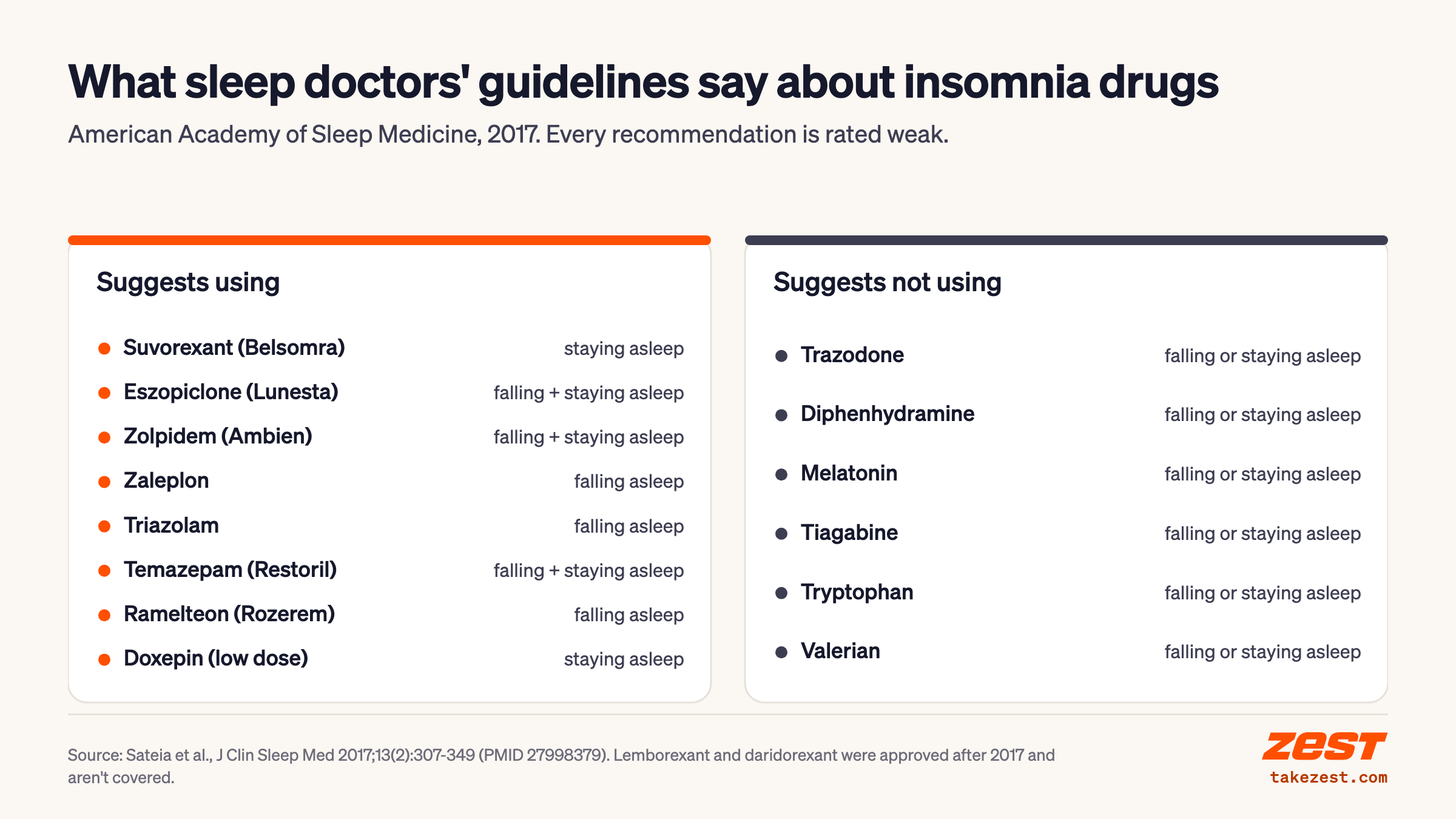
The American Academy of Sleep Medicine's 2017 guideline on sleep medications for chronic insomnia takes a different view: it suggests that clinicians not use trazodone for trouble falling asleep or staying asleep. It is a weak recommendation, meaning lower certainty.
Trazodone side effects
The label's figures come from its controlled clinical studies for the approved use, depression. These are the outpatient results:
| Side effect | Trazodone | Placebo |
|---|---|---|
| Drowsiness | 41% | 20% |
| Dry mouth | 34% | 20% |
| Dizziness or light-headedness | 28% | 15% |
| Headache | 20% | 16% |
| Blurred vision | 15% | 4% |
| Nausea or vomiting | 13% | 10% |
Trazodone carries a boxed warning, the FDA's strongest: antidepressants increased the risk of suicidal thoughts and behaviors in children and young adults in short-term studies, and anyone taking one should be watched for worsening mood or new suicidal thoughts. Other label warnings:
- Priapism: painful, prolonged erections have been reported. An erection lasting more than 4 hours needs emergency care, because it can cause permanent damage.
- Heart rhythm (QT prolongation): trazodone prolongs the QT interval. A dangerous rhythm (torsade de pointes) has been reported at doses of 100 mg or less. The label says to avoid it with other QT-prolonging drugs or a history of arrhythmias.
- Serotonin syndrome, a potentially life-threatening reaction, especially with other serotonin drugs such as SSRIs, triptans or tramadol.
- Low blood pressure on standing (orthostatic hypotension) and fainting.
- Higher bleeding risk with aspirin, NSAIDs or blood thinners; low sodium, especially in older adults; mania in people with bipolar disorder; and angle-closure glaucoma.
- Next-day impairment: it can slow thinking and motor skills, so the label cautions against driving until you know how it affects you.
Get medical help right away for any serious effect.
Trazodone vs. Ambien
| Trazodone | Ambien (zolpidem) | |
|---|---|---|
| FDA-approved for | Major depressive disorder (sleep use is off-label) | Short-term treatment of trouble falling asleep |
| How it works | Serotonin reuptake inhibition and 5-HT2 blockade | Boosts GABA to sedate the brain |
| Controlled substance | No | Schedule IV |
| Boxed warning | Suicidal thoughts and behaviors in young people | Complex sleep behaviors |
| Half-life | Not stated in the current label | About 2.5 hours |
| AASM 2017 guideline for insomnia | Suggests not using (weak) | Suggests using (weak) |
| Generic available | Yes | Yes |
Neither is right for everyone. See our guide to Ambien (zolpidem) and our comparison of low-dose doxepin for sleep, which is FDA-approved for staying asleep.
How to get trazodone prescribed
Trazodone needs a prescription from a licensed clinician after an evaluation of your sleep, mood, heart health and other medications. Good sleep habits and cognitive behavioral therapy for insomnia (CBT-I) remain the first step; medication works best alongside them. A clinician can also explain the FDA-approved options; our overview of prescription sleep medications is a good place to start.
Zest RX for sleep. Zest is preparing to launch telehealth for sleep, connecting you with licensed providers who can evaluate whether a prescription option fits your needs. Join Zest RX early access.
Frequently asked questions
Is trazodone FDA-approved for sleep?
No. Trazodone is FDA-approved only for major depressive disorder in adults. Prescribing it for insomnia is off-label, which is legal and common, but the FDA has not reviewed it for that use and the label gives no sleep dose.
No. Trazodone is FDA-approved only for major depressive disorder in adults. Prescribing it for insomnia is off-label, which is legal and common, but the FDA has not reviewed it for that use and the label gives no sleep dose.
Is trazodone addictive?
Trazodone is not a controlled substance, and the label reports no sign of drug-seeking in clinical studies, though its abuse potential has not been formally studied. Stopping suddenly can cause discontinuation symptoms, so the label recommends tapering.
Trazodone is not a controlled substance, and the label reports no sign of drug-seeking in clinical studies, though its abuse potential has not been formally studied. Stopping suddenly can cause discontinuation symptoms, so the label recommends tapering.
Is trazodone a controlled substance?
No. The FDA label states that trazodone is not a controlled substance, so it has no DEA schedule. Ambien and Belsomra, by contrast, are Schedule IV controlled substances.
No. The FDA label states that trazodone is not a controlled substance, so it has no DEA schedule. Ambien and Belsomra, by contrast, are Schedule IV controlled substances.
How long does trazodone last?
The current tablet label does not state a half-life. Levels peak about 1 to 2 hours after a dose, and the label notes it may build up in some people. It can cause next-day drowsiness, so avoid driving until you know how it affects you.
The current tablet label does not state a half-life. Levels peak about 1 to 2 hours after a dose, and the label notes it may build up in some people. It can cause next-day drowsiness, so avoid driving until you know how it affects you.
Can you take trazodone with alcohol?
The label says trazodone may strengthen the effects of alcohol and other sedatives. The patient guide says not to drink alcohol while taking it until you talk with your healthcare provider, because it can worsen sleepiness and dizziness.
The label says trazodone may strengthen the effects of alcohol and other sedatives. The patient guide says not to drink alcohol while taking it until you talk with your healthcare provider, because it can worsen sleepiness and dizziness.
Is there a generic for trazodone?
Yes. Trazodone has been available as a generic for decades, from many manufacturers, in 50, 100, 150 and 300 mg tablets depending on the maker. The original brand, Desyrel, has been discontinued.
Yes. Trazodone has been available as a generic for decades, from many manufacturers, in 50, 100, 150 and 300 mg tablets depending on the maker. The original brand, Desyrel, has been discontinued.
Sources
- Trazodone hydrochloride tablets prescribing information, Teva. DailyMed
- Sateia MJ, et al. Clinical Practice Guideline for the Pharmacologic Treatment of Chronic Insomnia in Adults: An American Academy of Sleep Medicine Clinical Practice Guideline. J Clin Sleep Med. 2017;13(2):307-349. PubMed
- Everitt H, et al. Antidepressants for insomnia in adults. Cochrane Database Syst Rev. 2018;5:CD010753. PubMed
- Yang X, et al. Efficacy, Acceptability, and Tolerability of Trazodone in Insomnia Symptoms: A Systematic Review and Dose-Response Meta-Analysis. Clin Drug Investig. 2026. PubMed
- AMBIEN (zolpidem tartrate) prescribing information. DailyMed
SLEEP
INSOMNIA
SLEEP MEDICATION